

Fiducial Markers Overview: Types, Use Cases, & Comparison Table

Guide to Fiducial Markers: Exploring Types, Applications, and Key Differences
Accurate data tracking and measurement are constant challenges in numerous use cases. Can fiducial markers become a solution? Let’s find out.
For instance, the medical industry requires colossal accuracy, and even a 1 millimetre deviation can jeopardize a surgery’s outcome.
Misaligned virtual surfaces in AR can disorient users. For instance, some objects may appear closer than their physical counterparts.
Fiducial markers represent a powerful tool to address these pain points for various applications and computer vision tasks, such as object detection, camera pose estimation, and anything that requires a robust source of image features.
People often mistakenly think of fiducial markers only as square binary codes, which limits their understanding of their true potential. Fiducials are designed for easy detection in different lighting, angles, and distances, making them reliable tools for real-world settings.
This comprehensive guide delves into the topic and highlights fiducial marker benefits and the following aspects:
- Types of fiducial markers and their properties.
- Applications of fiducial markers across different industries.
- Comparison of fiducial markers with their strengths and limitations for better decision-making.
Let’s dive right into defining what is a fiducial marker.
What Are Fiducial Markers and Their Benefits
Fiducial markers are created objects like black-and-white grids, checkerboards, or shapes with certain patterns. These markers are set in an environment or scene to help imaging systems find reference points.
The term “fiducial” comes from the Latin – fiducia, meaning trust, reflecting their function as dependable reference points for spatial measurements.
Designed for easy detection by cameras and algorithms, these markers enable precise 3D tracking. Typically, each fiducial marker is part of a system with a detection algorithm and coding. Detecting any marker generally carries information about its location on the image, orientation, and unique ID.
To make things even more straightforward, here is a simple explanation. Since images lose information about the captured scene depth, it is difficult to estimate the dimensions of an existing object properly.
This issue may be solved by placing an object with well-known dimensions, such as a ruler, in the field of view. In this case, the ruler is a reference point and stands for a fiducial marker.

In computer vision development services, fiducial markers have similar purposes and expand in more ways of estimating camera geometry properties. Cameras can detect and interpret these marked objects to calculate position, orientation, and scale.
Interested in knowing how to overcome industry challenges with cutting-edge fiducial markers?
At It-Jim, you can explore our 10+ years of expertise in building computer vision solutions. We have proven experience designing and integrating various tech systems for existing businesses or new innovative projects.
To sum things up, the fiducial marker benefits are as follows:
- Accuracy: offers reliable reference points for precise positioning, alignment, and tracking. This feature boosts spatial accuracy in complex systems like imaging devices, robots, and AR platforms.
- Automation: streamlines calibration and alignment. This fiducial marker property enables machines to operate with minimal human help in robotics and automated inspection processes.
- Repeatability: ensures consistent results in repeated imaging. This use case is vital in medical imaging, 3D scanning, and automated manufacturing.
- Simplification: makes tasks like object detection, 3D reconstruction, and spatial navigation easier.
- Real-time tracking: provides instant feedback for applications such as motion capture, drone navigation, and interactive simulations.
- Cost-effectiveness: provides affordable, high-value solutions for enhanced functionality and performance.
These fiducial marker benefits make them invaluable in both research and commercial applications.
Once correctly applied and set up, they help with tracking, localization, camera calibration, and object detection in applications like robotics, augmented reality, and manufacturing.
Types of Fiducial Markers
In typical computer vision, many fiducial marker systems exist. They differ primarily in their appearance and coding systems.
Generally, we can group all markers by their shape: circular, square, and topological. DL-based fiducial markers have also evolved in recent years, leading to another subclass.
Next, we will explore the most common fiducial marker types, their designs, and unique features for 3D computer vision services.
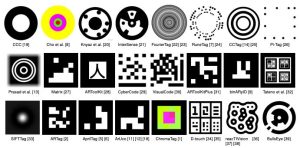
1. Circular Fiducial Markers
According to the studies, most round markers rely on the relative positions of inner circles, such as CCC, Cho, and CCTag. Based on their foundations, developers created more advanced Knyaz and InterSense systems. These novel fiducial markers use more complex coding.

Circular markers are less popular now. This is because they are less accurate and do not help with 2D point localization.
According to the ResearchGate publication, one of the most successful circular markers is RuneTag, which uses a large number of points. This feature boosts its pose estimation and resistance to occlusions. Yet, it does slow down performance.
Thus, circular markers are primarily used in pose estimation tasks. This is because these tasks often deal with occlusion in the scene.
2. Square Fiducial Markers
The most common fiducials are square markers, called binary or checkerboard. Their essence lies in coding information into an internal structure with a binary grid. Another advantage is that they return complete information, including corner positions, pose, and ID.
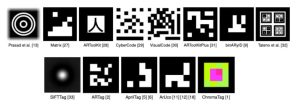
The first square marker ideas were implemented in systems like Matrix, CyberCode, and VisualCode. These days, their work principles are outdated and inefficient.
Currently, the top markers in this category are ARToolkitPlus, ARTag, AprilTag, and ArUco. ARToolkitPlus is a modern evolution of ARToolkit, which initially introduced the concept of image binarization.
All further systems were gradually improving versions of the previous ones:
- ARToolkitPlus and ARTag are enhanced versions of ARToolKit.
- AprilTag and ArUco are enhanced versions of ARTag.
Another interesting example is the ChromaTag, a colorized version of the AprilTag. According to the publication, its significant advantage over similar versions is its fast detection speed while keeping the same level of accuracy.
On the other hand, this marker is more sensitive to a large angle of view and long distances. Therefore, even the authors of ChromaTag recommend using AprilTag in these use cases.
As a result, AprilTag and ArUco markers are regarded as some of the most reliable and high-performing fiducial markers available. They operate on the same principles but use various algorithms to compute dictionaries.
ArUco markers are especially popular since OpenCV has included their implementation as a submodule.
3. Topological Markers
This type of fiducial marker has a more complex and diverse structure. D-Touch and ReactVision were the very first examples and are no longer relevant.
A recent piece of research in the field of topological markers was the TopoTag. This fiducial example uses an inner binary structure similar to checkerboard markers.

TopoTag’s authors achieve high robustness and near-perfect detection accuracy. These markers offer more feature correspondences for better pose estimation. Compared to square markers, they are also better at resisting occlusions.
In the evolution of fiducial markers, topological patterns struggled against other types. However, recent studies show they may outshine even the steadfast ArUco.
4. DL-based Markers
The previous markers used traditional computer vision methods for detection. In contrast, the DL-based systems utilize trained models.
Few DL-based systems can match the best marker models yet, this field is still evolving. The recent work is E2ETag, as well as the findings of the DeepFormableTag.
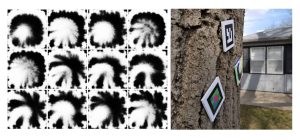
Automated processes generate structures and consist of various textures with diverse forms and colors. The E2ETag can tackle tough scenes with poor exposure, motion blur, and noise.
The DeepFormableTag uses RGB info. This model can be detected on convex surfaces, which is tough for non-DL-based fiducials. In contrast, neither system supports pose estimation.
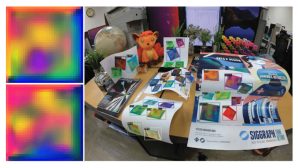
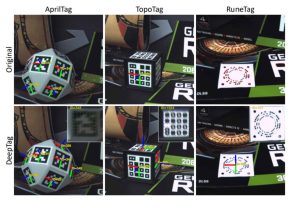
Approaches supporting the existing markers mentioned earlier have also been developed. One recent proposal is DeepTag. It is a deep learning-based framework designed for the creation and detection of fiducial markers.
Its authors experimentally proved that DeepTag may detect fiducials more precisely than classical methods, even at complex angles. This framework also pulls more key points from a marker’s internal structure, making pose estimation more accurate.
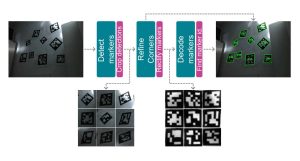
Another enhancement is DeepArUco++, which improves upon classical ArUco markers by integrating convolutional networks for robust detection, corner refinement, and decoding. It particularly excels under adverse lighting conditions where traditional pipelines often fail.
A recent innovation is YoloTag, a real-time detection system built on YOLOv8, primarily aimed at UAV navigation. Rather than designing a new marker structure, it treats the fiducial markers as generic objects. These are detected using object detection and localized via a PnP pose estimation algorithm.
This system enables efficient, marker-based localization in large-scale outdoor environments without relying on precise marker geometry.
5. Non-visual Markers
Not all markers are meant to be seen. A growing line of research explores fiducials that operate outside the visible spectrum, quietly supporting perception where cameras may struggle or aesthetics matter.
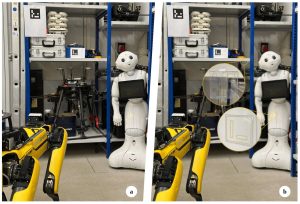
iMarkers, introduced in 2025, are designed to blend in. They are entirely invisible to the human eye, yet detectable by specialized sensors. Invisible fiducial markers offer a discreet way to embed localization cues into everyday spaces, functional in environments like homes or public installations where visual clutter is unwelcome.
L-PR, on the other hand, speaks to machines in 3D. Developed for LiDAR-based systems, it encodes information into geometric patterns that remain effective even when views are sparse or misaligned. When visual cues fall short, it is a practical robotics, mapping, and 3D reconstruction tool.
Key fiducial marker properties:
- Circular markers, such as CCTag and a more advanced version – RuneTag, excel in precision tasks like camera calibration due to their robustness to perspective distortion.
- Square markers, like ArUco and AprilTags, are widely used for their simplicity and effectiveness in AR and robotics, though they may struggle with occlusions.
- Topological markers, exemplified by TopoTag, offer high robustness and scalability, supporting thousands to millions of unique IDs for complex applications.
- DL-based markers, like those using DeepTag or DeepArUco++, leverage deep learning for flexible detection. They may provide greater robustness, but demand increased computational resources.
- Non-visual markers, such as iMarkers and L-PR, operate beyond the visible spectrum through infrared, LiDAR, or other sensing modalities. They enable detection where vision fails or visibility is not an option.
Want to know how best to apply fiducial markers in your case?
Reach out to our experts for personalized advice on boosting your innovative project or existing business with a full-scale development solution.
Comparison of Fiducial Markers
Different applications require different fiducial marker properties.
The following table provides the pros and cons of fiducial markers, namely square, circular, topological, DL-based, and non-visual:
| Market type | Circular | Square | Topological | DL-based | Non-visual |
| Examples | CCTag, CCC, Cho | Matrix, CyberCode, VisualCode, ARToolkitPlus, ARTag, AprilTag, ChromaTag | D-Touch, ReactVision | E2ETag, DeepFormableTag, YoloTag | iMarkers, L-PR |
| Top examples | RuneTag | ArUco | TopoTag | DeepTag, DeepArUco++ | iMarkers |
| Design | concentric circles or dot patterns | square with binary patterns | topological patterns (connectivity-based) | custom patterns (consisting of various textures, diverse forms, and colors) or copies of existing | non-human-visible markers (e.g., infrared, LiDAR geometry) |
| Detection method | traditional CV (e.g., ellipse detection) | traditional CV (e.g., edge detection) | topological and geometrical analysis | deep learning (e.g., CNNs or similar trained models) | sensor-specific (e.g., infrared, LiDAR feature matching) |
| Robustness to occlusion | high (resistant to distortion and blur) | moderate (sensitive to partial occlusion) | very high (handles partial occlusion well) | very high (adapts to occlusions) | high (not affected by visible light occlusion) |
| Speed | moderate | fast | moderate | slow | variable (depends on sensor type and data processing) |
| Advantages | robust to perspective distortion, ideal for precision | simple to implement, widely supported, and efficient | near-perfect detection accuracy, scalable (millions of IDs), robust in dynamic settings | robust, flexible,
performs reliably even in challenging conditions such as poor lighting, motion blur, and image noise. |
unaffected by lighting, aesthetics preserved, work in darkness or clutter |
| Limitations | limited marker diversity, limited in 2D point localization, requires careful placement in cluttered environments | limited by occlusion, extreme angles and long distances | requires specialized algorithms | requires training, sometimes high resources (e.g., hardware) | requires specialized sensors and hardware |
| Computational cost | moderate | low to moderate | moderate to high | high | moderate to high (depends on sensing and decoding method) |
| Use cases (main applications) | pose estimation, calibration, precision tracking, etc. | AR, robotics, camera calibration, etc. | AR, robot navigation, biomedical imaging, robot navigation, warehouse automation, etc. | advanced applications, medical imaging, research, complex environments, etc. | robotics in low-light or cluttered areas, 3D mapping, AR |
By analyzing these properties of fiducial markers, developers and engineers can tailor their systems for optimal performance.
You may consider the size, shape, and detectability of fiducials as well as the following factors when selecting the appropriate fiducial marker system:
1. Environment
Answer the question: “Will the fiducial be used indoors, outdoors, or in low-light conditions?”.
Consider durability, which can be especially important in long-term or harsh environments. Square markers suit controlled settings, while circular and topological markers excel in challenging conditions. DL-based markers offer maximum flexibility for extreme variability.
2. Precision Needs
Circular markers like ChArUco or CCTag are best for sub-pixel accuracy (e.g., calibration). For general tracking, ArUco or AprilTags suffice. Topological and DL-based markers provide robust alternatives for complex scenes.
3. Speed Requirements
Square markers are the fastest for real-time applications, followed by circular and topological markers. DL-based markers are the slowest but are improving with optimization.
4. Scalability
Topological markers are ideal for applications needing millions of unique IDs, while square and circular markers support smaller sets.
5. Computational resources
If you are working with limited processing power (e.g., mobile devices), ArUco is more efficient than AprilTags. Square markers are lightweight; circular markers are moderately demanding; topological markers require specialized algorithms, and DL-based markers need significant computational power.
6. Cost
Square markers benefit from mature libraries (e.g., OpenCV), while topological and DL-based systems may require custom development. Passive markers like ArUco or QR codes are inexpensive, while DL-based markers require investment in hardware.
Fiducial Markers: Applications & Use Cases
Fiducial markers are versatile. They can be used in many industries and research areas. Below are some typical applications of fiducial markers within the computer vision domain:
1. Augmented and Virtual Reality
In our experience, fiducial markers are widely used in augmented reality services. It enables the integration of digital content, such as virtual 3D objects, into real-world environments.
The main goals of AR apps are to analyze live camera feeds and accurately overlay virtual elements into the real scene using tracking data. AR systems can also accurately find real-world position, orientation, and scale.
They can do this by using fiducial markers with specific patterns and sizes. Marker-based AR tracking is a widely adopted method in AR. It offers high precision by using visual references, ensuring a stable, precise alignment between the virtual and real-world visuals.
Use cases: AR gaming, training simulations, interactive museum exhibits, etc.
2. Robotics and Automation
Fiducial markers play a key role in improving robotic skills. They help with localization, object recognition, and path planning.
High-contrast patterns like ArUco help with navigation. They are camera-detectable and work well where feature detection algorithms may fail. Research highlights how they boost robot autonomy in the industrial, medical, and logistics fields.
Use cases: Warehouse robotics, drone and auto navigation, robotic arms
3. Manufacturing and Quality Control
Fiducial markers are used to maintain high-quality manufacturing standards. They boost efficiency, reduce errors, and guarantee high-quality results in many fields, especially in electronics manufacturing.
They help improve assembly by guiding where to place components. They also inspect and verify product quality and assist with calibrating machines for accurate measurements.
Use cases: 3D printing calibration, parts and products verification
4. Motion Capture and Animation
Fiducial markers are common in motion capture (mocap) and animation. They help record human and object movements accurately. This data is used in areas like film production, sports science, and biomechanics.
High-speed cameras detect their positions in 3D space, enabling detailed motion reconstruction.
Use cases: Animation, athletic performance analysis, etc.
To Conclude About Fiducial Markers
The fiducial marker technology is a foundational tool for the interface between physical and digital systems. Fiducial marker systems impress with their variety of shapes, appearances, and detection approaches.
In this article, we reviewed some popular makers: square, circular, topological, DL-based, and even invisible. These systems cater to different needs, with no single type being universally superior. The choice depends on your specific application. Developers and engineers can select or design the optimal solution tailored to their particular needs through an informed comparison of fiducial markers.
To conclude, fiducial marker technology continues to evolve, integrating advances in materials science, computer vision, and custom AI solutions. These innovations promise even greater benefits in emerging fields like personalized medicine, autonomous vehicles, and immersive computing.
Still unsure about which marker type fits properly for your project?
Let us help you make the best choice during a detailed consultation. Explore our computer vision expertise and get in touch to start integrating CV and fiducial markers into your next project.
