
02 · Research
Technical research: a two-week AI feasibility study on your data
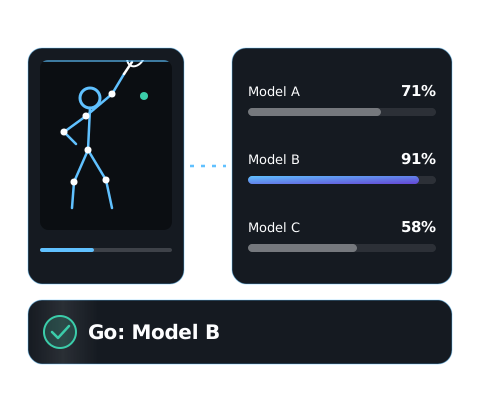
A two-week AI feasibility study on your recordings, at a fixed price. Two or three candidate models run on your data with accuracy measured rather than estimated, a catalogue of where they fail, a cloud or on-device decision backed by numbers, and a proof of concept roadmap with a fixed price. It ends with a written go or no-go.
Who it is for
Is this the right step for you?
- You promised a camera feature to customers or investors and have no proof yet that it can be measured.
- Your current model counts wrong and nobody on the team can say why.
- You are choosing between an SDK, a cloud vision API and a model of your own.
- Your CTO has already researched the problem with Claude or ChatGPT and now needs numbers from real footage.

What you get
Technical research: the deliverables
- 01
Numbers on your own recordings: two or three candidate models, each scored on a test set we build from your footage.
- 02
A catalogue of where it breaks: clips of failures on fast motion, low light, occlusion and cheap cameras, drawn from your data and from 200+ past projects.
- 03
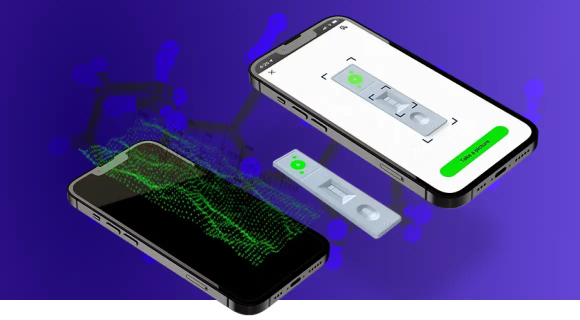
Cloud or device, decided with evidence: the best model converted to CoreML or TFLite, timed on a low-end Android and an older iPhone, with the accuracy lost in conversion measured. Cost per user at your scale for cloud, on-device and a per-user SDK.
- 04
A data audit: whether your data is usable, how much more you need, what labelling will cost, and annotation guidelines.
- 05
A licence check of every model and dataset we recommend, so the code and IP can pass to you.
- 06
A technical report, an architecture outline and a PoC roadmap with a fixed price and timeline.
- 07
An online demo deployed in the cloud, so your team can try the best candidate on new recordings.
How it works
From first message to done
- 1
Week 1: data audit, test set, baseline accuracy on the candidate models, failure catalogue.
- 2
Week 2: on-device conversion and timing, cost model, report, demo deployment.
- 3
Day 10: a read-out call with the engineers who did the work. The go or no-go arrives in writing the same day.
About 100 engineering hours. It starts after the free assessment.
A written go or no-go with a priced plan for the proof of concept. A no is a valid result. In our experience close to half of camera features that look feasible on paper fail on real recordings, and finding that out at a fixed price is the point.
Compared with the alternative
A capable engineer with a chatbot can list candidate models, read papers and draft an architecture. What that setup cannot do is run the models on your footage with labelled data and GPUs, show you where they fail on cheap phones, measure what conversion to CoreML costs in accuracy, check the licence of every dataset, or commit to a PoC price that the same team will deliver. Those are the parts you are paying for.
Questions
What teams ask about technical research
Yes, when the assessment finds the task well understood. Otherwise the research is what makes the PoC price fixed.
Recordings from real users or sessions, in the conditions the feature will meet. If you have none, we tell you what to film.
You do. The report, the demo code and the test set are yours, whatever you decide next.
How we work
What you can count on
How will we know the AI is any good?
Success metrics are agreed before a line of code, and the report scores against them. No technical background is needed to read the result.
What if the concept does not work?
You get a written no with the evidence. Expectations are set at the start; in our experience close to half of ideas stop here.
Are you reinventing the wheel?
No. Candidates are open-source and foundation models first. The research measures where out of the box stops being enough.
Next step
Send what you have. Verdict in a day.
Start with the free assessment. If the task is measurable, the research is the next step.
- 1You send a spec and a few recordings
A paragraph on the feature, a link to clips or sensor logs, the platforms. NDA first if you need one.
- 2An engineer reviews it
The CTO or a domain expert goes through the measurement, the conditions and the platforms.
- 3You get the verdict within a day
Whether the feature can be measured, the risks we see, and the recommended next step, in writing.