Industry: Biotech

AI-Powered Biotech Software Development Services

Have your biotech images measured by AI, not by eye. Objective, repeatable numbers that hold up in a review.

Overview

Transforming Biotech With AI and Computer Vision

Biotech software development services are usually scoped around data management: a laboratory information management system (LIMS), an ELN, a pipeline from instrument to database. Applying AI changes the question, because the hard part of an AI-driven imaging or assay model is rarely the architecture. It is the biology behind the pixels: uneven lighting, camera-to-camera differences, and ground truth that experts label differently. We learned this on projects where images came from phone cameras and test strips as much as from lab equipment. As a custom biotech software development company, It-Jim builds the AI layer that plugs into those systems, from imaging setup and annotation through the model to the application your scientists use daily.

Services

Custom Biotech Software Development Services

Some teams arrive with an imaging question and no data pipeline. Others arrive with a running lab workflow that needs automation. Our biotech AI solutions development services cover both ends.

  1. 01

    Custom Biotech AI Software Development

    This is our core: full-cycle development of AI-enabled biotech software, from the first data pipeline to a scalable system in daily use. We choose classical image processing or deep learning per task and build the interface your scientists use.

  2. 02

    Biotech Software Consulting & Technical Discovery

    Our AI consulting services test on your own images or assay data whether the idea can work, and review an existing pipeline for weak spots. You get a verdict to plan a budget around.

  3. 03

    Proof of Concept and AI Prototyping

    A proof of concept answers one question: does the method work on your samples? In two to three months we build a working prototype and report measurable results on real data. Sometimes the honest answer is that the technology is not ready yet, and learning that now is cheap.

  4. 04

    Computer Vision Software Development for Biotech

    Microscopes, plate imagers, and phone cameras each have their own noise and failure modes. We build computer vision that segments, counts, and measures what is in them, and analytics that summarize results. Our cortisol test reader, which works from an ordinary phone camera, came out of our computer vision work.

  5. 05

    AI Model Development and Integration

    We train, tune, and compress models on your data, then integrate AI with the existing systems your lab already runs, including LIMS, ELN, and instrument software. The model's output lands where decisions are made, not in a notebook on one laptop.

  6. 06

    Annotation and Dataset Preparation

    In biology, the labels are half the product. We design annotation protocols with your scientists, measure how often experts disagree, and use synthetic data to accelerate training where samples are scarce.

  7. 07

    Model Validation and Lifecycle Support

    A model that passes on last month's batch can drift when a reagent lot or imaging device changes. We test AI systems on held-out experiments and set up monitoring that catches degradation early. Ongoing support means we retrain and verify when something shifts.

Solutions

AI Biotech Solutions We Build

The right AI solutions for biotech turn images and assay data into measurable outcomes a scientist can put in a paper or a batch record. Our biotech AI solutions development covers the applications below, delivered as custom software solutions.

01 / 06

Microscopy Image Analysis

Microscopy produces more images than a team can review, and review by eye varies by person. We build image analytics pipelines that streamline review and judge every image by the same rule.

Use cases

  • Morphology and confluence measurement in cell culture
  • Intensity quantification across wells and plates
  • Longitudinal monitoring and run-to-run comparison of image sets

Ideal for

  • Biotech Startups
  • Pharma R&D
  • Contract Research Organizations (CROs)
  • Academic Labs

02 / 06

Medical and Scientific Image Segmentation

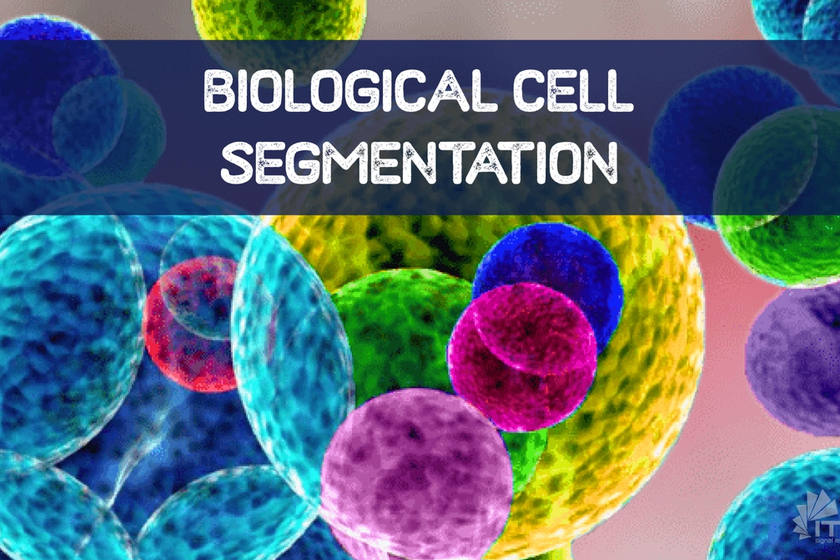
Segmentation answers where each structure begins and ends, and every later measurement depends on it. We train segmentation models on your images to outline cells, nuclei, and tissue regions and accelerate later measurement.

Use cases

  • Cell and nucleus boundary outlining
  • Tissue region segmentation on stained slides
  • Measurement on scientific and medical images

Ideal for

  • Pharma
  • Diagnostics
  • Cell Therapy
  • Academic Research

03 / 06

Cell Detection, Counting and Classification

Detection finds each cell, counting totals them, and classification says what state each is in. Together they reduce manual counting that shifts with the counter.

Use cases

  • Cell counting for viability and confluence checks
  • Counting objects across plate images
  • Classifying cells by morphology

Ideal for

  • Biotech
  • Pharma
  • Contract Research Organizations
  • Biomanufacturing

04 / 06

Anomaly and Defect Detection

A faulty sample looks wrong in unpredictable ways, so a fixed rule misses it. These models learn what normal looks like and flag the rest, catching failed wells, imaging artifacts, and malformed samples.

Use cases

  • Catching samples that look different from the rest
  • Flagging failed wells and artifacts before analysis
  • AI-assisted pre-screening of medical images before a specialist review

Ideal for

  • Biomanufacturing
  • Diagnostics
  • Pharma
  • MedTech

05 / 06

Research and Discovery Apps

Biotech software development only pays off when a scientist can run the model without a developer. We wrap analysis pipelines in web or desktop applications: systems that support your research workflows instead of sitting beside them.

Use cases

  • Review screens for flagged images with one-click label correction
  • Dashboards that compare runs, plates, and conditions
  • Correction loops that turn expert fixes into training data

Ideal for

  • Biotech Startups
  • Academic Labs
  • Pharma R&D
  • Diagnostics

06 / 06

Smartphone Assay and Test Strip Reading

A rapid test shows a line or a shade that people read as yes or no. A phone camera can turn it into a measurable result.

Use cases

  • Quantifying lateral flow and colorimetric tests
  • Reading diagnostics from a phone photo
  • Keeping the image with each result for experiment documentation

Ideal for

  • Diagnostics
  • MedTech
  • Wellness
  • Pharma

Can't Find the Solution You Need?

Maybe you are testing a first custom AI idea on real samples, or replacing a manual workflow that stopped scaling with your data. Either way, one conversation with our engineers shows the shortest path to a working solution.

How Much Do Biotech Software Development Cost?

Cost in biotech AI comes from the data and the validation more than from the code. One clean imaging setup is a small project; three instruments across two sites is a different one. Biotech software development services are priced by the factors below, after we have looked at your data.

What Drives the Cost of Biotech AI Development

  • Volume, quality, and labeling of your images, assay data, or other research data
  • Imaging devices, sites, and protocols the model must cover
  • Accuracy targets, and how they will be validated
  • Integration with LIMS, ELN, or instrument software

Where to Start With a Limited Budget

The entry steps are small, and each buys a decision. A two-week research sprint tests your data and prices the rest of the project. A proof of concept of two to three months delivers a working demo on your samples, and a full build follows only if the numbers justify it.

Why Staged Budgets Protect Biotech Teams

Paying for a full build before testing the data is the expensive way to learn a model does not carry over to a second batch. A staged budget surfaces that in the first weeks, and strong results become the basis of scalable product development.

Process

Our Approach to Biotech Software Development

Typical biotech software development begins with a requirements document and a mockup. Our development approach starts with your samples and imaging setup, follows the model through its full development lifecycle, and stays on through AI adoption.

Technologies

Technologies we Work With

  • Image Processing & Enhancement
  • Object Detection
  • Instance & Semantic Segmentation
  • Object Counting & Measurement
  • Anomaly Detection
  • Active Learning & Annotation Tooling
  • Smartphone Colorimetric Analysis
  • Model Compression & Edge Deployment
  • MLOps & Model Monitoring

Why It-Jim

Why Choose It-Jim as Your AI Biotech Software Development Company

  • 200+projects delivered

    A track record of real-world deployments in computer vision and machine learning.

  • 10+years of expertise

    A decade of AI development services across industries.

  • Built by engineers, not hype

    Engineers founded It-Jim and engineers run it. You talk to the people who build your model, and they say so when the data cannot support the claim.

  • Problem-Solving Obsession

    Messy images, small datasets, and ground truth that experts dispute are the problems we ask for.

  • PhDs on the Team

    Advanced degrees in artificial intelligence, computer vision, and physics give us deep expertise in optics, noise, and statistics.

  • Innovation-Ready Mindset

    We treat every project as applied research, which shows in how fast prototypes appear, with measurable results on your own data.

Engagement

Our Biotech AI Development Engagement Models

Committing to a full build on day one rarely makes sense, and our engagement models reflect that. Each format of our computer vision software development services matches a different stage of certainty, from the first question to a live product.

  1. Step 1

    Exploration & Technical Research

    A focused 2-week sprint to analyze your data and define a clear path to a Proof of Concept.

    You get

    • a technical report
    • concept architecture
    • a PoC roadmap
  2. Step 2

    Proof of Concept (PoC)

    A 2-3 month build of a functional demo tailored to your task and environment.

    You get

    • working prototype
    • validation of idea
    • delivery without risks

    Best for: startups, R&D teams, or innovation units validating a use case before scaling.

  3. Step 3

    Full Product or MVP

    We develop the complete system – from front‑end to back‑end to the custom computer vision core.

    You get

    • a deployable product
    • built for real users

Have a Biotech AI Challenge? Let's Explore It.

Questions

Biotech Software Development Services FAQs

Biotech software development services are the design and engineering of software for biotech research, development, and production, from laboratory data systems to artificial intelligence and analytics for images and assay data. The AI side covers models that segment and count structures in images, flag anomalies, and read tests. It-Jim builds that AI side, including biotech app development.

Yes, within limits that depend on your images. Segmentation, detection, and classification models can measure cells and tissue regions in microscopy images, but staining, focus, and illumination matter as much as the model. A research sprint on your own images shows how well it works before you commit to a build.

A technical research sprint takes two weeks, and a proof of concept takes two to three months. A full biotech software development project varies with scope and data readiness, but you will know the timeline before development starts.

Yes. Biotech AI software can run on a workstation beside the microscope, on a server inside your network, or on the device itself, which keeps confidential images within your data protection and security requirements. Cloud (AWS, Azure, GCP) suits many users sharing one system.

We test it on data it has never seen, ideally from a different batch or instrument, and compare the output with expert annotation. Because experts disagree with each other, we measure that disagreement first and treat it as the accuracy ceiling. We also report where it fails.

Any step in your workflow where a person looks at images or readouts and writes down a number is a candidate for automation: counting, measuring, and the first pass of image review. Steps that need scientific judgment stay with your team.

Build Your Biotech AI Solution With It-Jim

Have a challenge in mind or just exploring? Talk directly with an engineer. No pitch. No fluff.

Tell us about your project
Chat on WhatsApp
File upload (optional, up to 15 MB)

By submitting this form, you agree with our Privacy Policy

What Happens Next?
  1. Your message goes straight to our core team – not a sales department.
  2. You’ll talk directly with our CEO, CTO, or a domain expert for a consultation-style first call.
  3. We’ll ask the right technical questions to understand your challenge and scope.
  4. If we’re a fit, we’ll follow up with a proposed path forward.