

Top Free Chat GPT-3 Alternatives for Developers & Businesses

Top Free and Open-Source GPT-3 Alternatives to Cover Your Business Needs
Large Language Models (LLMs) have emerged as highly successful and widely adopted AI technologies in recent times. Major players in the industry, including OpenAI, Google, Nvidia, Meta, and Microsoft, leverage these models either for their products or to offer access to them.
Among the current LLMs, GPT-3 (Generative Pretrained Transformer) and its successor, GPT-4, reign supreme in terms of popularity. Developed and released by OpenAI, GPT-3 possesses the remarkable ability to generate text that closely resembles human language.
It has been put to the test across various domains, including poetry, chatbots (such as ChatGPT), machine translation, QA, and even coding. All GPT-3 required to generate such content is a prompt with instructions expressed in human language.
These huge models often serve as the foundation for customers’ own AI products, for which they fine-tune the LLMs with minimal additional training. But models like OpenAI’s GPT-3 are proprietary; their source code is not freely available, and access to their capabilities comes at a cost. The GPT-3 is available through OpenAI’s API, but the API is expensive, even though OpenAI recently dropped the price for it.
Despite the costs and proprietary nature of GPT-3, which has limited its usage and applications, a vibrant community of researchers and enthusiasts has emerged, actively working on developing an open-source Chat GPT free alternative for harnessing the power of large language models today.
Benefits and Challenges of Open-Source Chat GPT3 Alternative
As we have discussed, GPT-3 presents certain drawbacks regarding data privacy, customization, and costs. regarding data privacy, customization, and costs. Fortunately
Benefits of Chat GPT-3 Alternative
What are the benefits of utilizing free alternatives to GPT-3? Let’s explore:
1. Open-source code
These Chat GPT alternatives provide developers with the freedom to customize the model and automate processes, all without compromising on features or security.
2. Enhanced control over data flow
By opting for a self-hosted chat GPT-3 alternative, you eliminate the need to transmit your data through external servers via an API. This grants you transparency and peace of mind regarding data privacy. Moreover, you can implement crucial safeguards to prevent any potential misuse of the technology.
3. Cost-effectiveness
The self-hosted LLM and some of the best ChatGPT alternatives are much cheaper to use, particularly when handling a substantial volume of requests.
Challenges of Open-Source Chat GPT-3 Alternatives
However, several challenges must be addressed for these alternatives to compete effectively:
1. Training data
The process of labeling training data for free ChatGPT alternatives requires significantly more manual effort compared to GPT-3, which benefited from the extensive resources of a well-funded organization and access to vast amounts of human-written data.
2. Scalability
To train language models rival and alternative to GPT-3, engineers require substantial computational power, which can pose difficulties for organizations with limited funding.
3. Human resources
While many NLP tasks are relatively straightforward and can be handled by individuals with basic proficiency, certain domains necessitate the expertise of highly skilled professionals. However, it may be challenging to find such professionals who are willing to contribute on an unpaid basis.
In this article, our focus will be on comparing various free alternatives to GPT-3, including GPT-Neo, BLOOM & BLOOMZ, FLAN-T5, OPT, and StableLM, in multiple tasks.
We will demonstrate how you can use these free GPT-3 alternatives independently. Before delving into the details of these alternatives, let us first provide a comprehensive overview of GPT-3.
GPT-3 Overview
GPT-3, developed by OpenAI, is the third iteration of their language model. It has been specifically designed to address various problems, including machine translation, question answering, and text generation.
By employing either few-shot or zero-shot learning, GPT-3 is capable of generating text and making accurate predictions. This versatility has made it a powerful tool for tackling various problem domains.
The model is constructed using large datasets and trained through unsupervised learning, enabling it to provide answers to questions without requiring manual input or specific training data.
The extensive capabilities and deep understanding of human language exhibited by GPT-3 have garnered recognition from the research community. However, due to OpenAI’s policies and limitations, many individuals have begun exploring free alternatives to GPT-3 to address their NLP challenges.
Currently, GPT-3 is available in four versions, each with varying capabilities and price points. Ada, the smallest and most affordable version, is followed by Babbage, Curie, and Da Vinci, which is the largest and most expensive.
While the exact number of parameters for each model has not been disclosed, estimations suggest that Ada has approximately 350 million parameters, Babbage has 1.3 billion parameters, Curie has 6.7 billion parameters, and Da Vinci boasts a staggering 175 billion parameters.

As a general observation, models with more parameters tend to offer improved accuracy, albeit at a higher cost. OpenAI calculates the pricing based on token usage, where approximately 100 tokens can be equated to 75 words. The pricing details for usage are outlined below:

Top 5 Free and Open-Source GPT-3 Alternatives
In this part, we discuss some ChatGPT free alternatives as one of the most popular Large Language Models. These best alternatives to ChatGPT are also trained on a vast amount of data to perform tasks such as translation, summarization, answering questions, and text generation.
1. BLOOM and BLOOMZ
BLOOM, developed by BigScience, is a multi-lingual open-source LLM that boasts a diverse community of contributors. The complete versions of BLOOM are freely accessible through Hugging Face Transformers.
By its nature, BLOOM is a casual, autoregressive language model, which means it was trained to predict the next token. A simple strategy for predicting the next tokens has demonstrated the ability to capture a certain degree of reasoning abilities in LLMs, enabling BLOOM and similar models to solve uncommon problems, such as arithmetic, translation, and programming, with fair accuracy.
BLOOM, as one of the best chat GPT alternatives, is built on the transformer architecture, which encompasses an input embedding layer, 70 transformer blocks, and an output language-modeling layer. Each transformer block comprises a self-attention layer and a multi-layer perceptron layer. The diagram below illustrates the architecture of the BLOOM model.
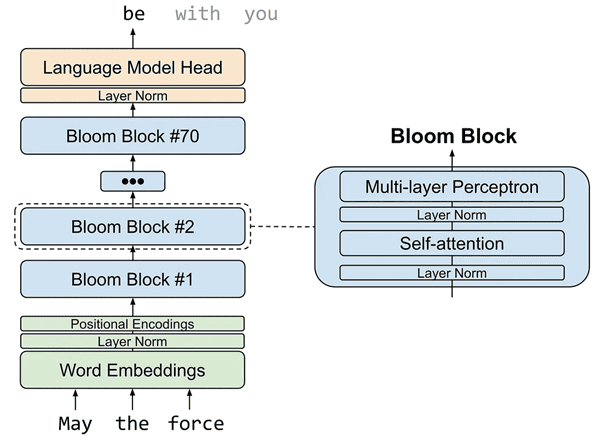
BLOOMZ is just a fine-tuned version of the BLOOM model on the xP3 dataset. The xP3 dataset comprises 13 training tasks across 46 languages, enabling the model to follow human instructions in dozens of languages without requiring zero-shot learning.
Both BLOOM and BLOOMZ exist in a few sizes:

2. GPT-Neo
GPT-Neo, an open-source large language model (LLM), was developed by EleutherAI to create more accessible AI for everyone. EleutherAI’s mission centers on creating and releasing open-source models and datasets, enabling a broader range of individuals to engage with artificial intelligence.
Due to the limited access to extensive datasets, EleutherAI sourced its dataset known as “The Pile,” which spans a substantial 825 gigabytes. This dataset comprises data from various sources, including PubMed, Wikipedia, GitHub, and others, providing a diverse range of information for training the model.
The architecture of GPT-Neo closely resembles that of GPT-2, with one notable distinction. GPT-Neo incorporates local attention in every alternate layer, utilizing a window size of 256 tokens. GPT-Neo was trained as an autoregressive language model, so its core functionality is to predict the next token in a sequence.
GPT-Neo, as one of the chat GPT 3 alternatives, is available in different sizes, ranging from 125 million to 2.7 billion parameters, allowing users to choose the variant that best suits their specific requirements.
3. FLAN-T5
FLAN-T5, developed by Google, stands as another notable free alternative to GPT-3. It is an enhanced version of the T5 model, which has undergone fine-tuning across a diverse range of tasks.
This approach significantly enhances the model’s performance in zero-shot learning scenarios. FLAN-T5 is a combination of a model and a technique of fine-tuning: T5 is a language model by Google, and FLAN refers here to a collection of instruction-based fine-tuning tasks and methods.

This model was trained on a large corpus of text data to predict missing words in an input text via a fill-in-the-blank style, which means FLAN-T5 is a masked language model.
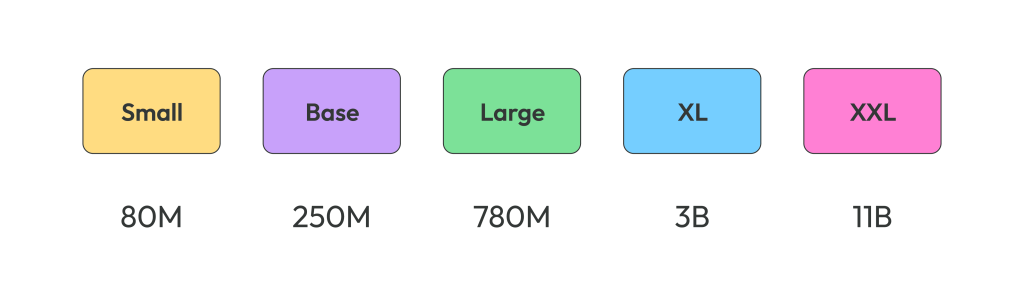
FLAN-T5 model, as a chat GPT free alternative, comes with a few variants:
4. OPT
Another noteworthy self-hosted alternative to GPT-3 is the OPT (Open Pretrained Transformer) model developed by Meta AI. It was introduced to the public in May 2022, offering a robust solution for various natural language processing tasks.
Primarily trained on English text, OPT contains a small amount of non-English data within its training corpus, sourced via CommonCrawl. The model was pretrained with a causal language modeling objective. OPT also belongs to the same family of decoder-only models as GPT-3.
The OPT model is available in various sizes. The available options span from 125 million to an impressive 175 billion parameters.
5. StableLM
StableLM, one of the latest additions to the open-source LLM landscape, comes from StabilityAI.
Currently, the alpha version of the model is available in two variants: 3B and 7B. However, the developers have promised to release larger models in the future, ranging from 13B to an impressive 65B.
To gain further insights into the comparison between StableLM and GPT-3 and GPT-4, you can refer to our brief post on the matter.
Based on EleutherAI’s GPT-J and GPT-NeoX models, StableLM was trained using an extended version of the ThePile dataset, which encompasses 1.3B tokens.
Comparing Performance: GPT-3 vs. Free GPT-3 Alternatives
In the table below, check out GPT-3 versus its top free and open-source alternatives, focusing on performance, scalability, and cost-effectiveness.
| Model | Performance | Scalability | Cost-effectiveness |
| GPT-3 (OpenAI) | Strong general performance; proprietary model trained on massive data scales. | Scalable through the OpenAI API; users pay for tokens. | Subscription and API costs: closed-source with paywalls and proprietary pricing. |
| BLOOM / BLOOMZ (BibScience) | Designed for multilingual tasks; performs well in many languages, competitive with GPT‑3 in specific areas like text generation. | Available in multiple sizes (560M – 176B); designed for distributed training and inference. | Open-source; training dataset and process fully transparent; compute-intensive for large models but cost-effective with community hosting options. |
| GPT-Neo / NeoX (EleutherAI) | Solid performance for basic use and simple text generation; below GPT‑3 on complex reasoning or few-shot tasks. | GPT‑Neo: up to 2.7B; GPT‑NeoX: up to 20B; scales reasonably well on consumer hardware. | Open-source and lightweight models; very cost-effective for smaller-scale applications. |
| FLAN‑T5 (Google) | Enhanced in zero‑shot learning via instruction fine‑tuning. | Versatile; available in multiple sizes, can run on TPU/GPUs for larger variants. | Entirely free/open-source; self-hosted infrastructure is required – no API fees, but requires compute investment. |
| OPT (Meta) | Comparable to GPT‑3 across tasks, matches GPT-3’s performance. | Models vary from 125 M to 175 B parameters, with flexible deployment options. | Open-source; less energy consumption (1/7 carbon footprint compared to GPT-3). It is self-hosted, so compute costs only. |
| StableLM (Stability AI) | Early-stage models; good performance on standard benchmarks for small models (1.5B – 7B); better for experimentation than production. | Currently available up to 7B; future larger models announced. | Open-source, very lightweight; ideal for budget-conscious developers and academic research. |
In terms of performance, open-source Chat GPT-3 alternatives such as FLAN-T5 and OPT achieve comparable results to GPT-3, particularly in instruction-following and zero-shot contexts.
The models we have discussed come in multiple sizes, ranging from hundreds of millions to hundreds of billions of parameters, allowing for flexible deployment on various hardware setups.
Since FLAN‑T5 and OPT are fully open-source, there are no licensing fees. You only need to consider hosting and computation costs, which are often significantly cheaper than GPT-3’s API pricing.
How to Implement GPT-3 Alternatives in Your Projects
Many developers and organizations strive to integrate open-source and free ChatGPT alternatives to get automation and streamlined business operations. As mentioned, models like FLAN-T5, OPT, or GPT-Neo offer this flexibility and integration possibilities.
Next, we outline the crucial steps to integrate these free ChatGPT alternatives into your application successfully.
1. Model selection and setup
Choose the right language model for your use case, whether you need an alternative to ChatGPT for translation, summarization, or similar. Also, assess your performance requirements and hardware constraints or limitations (e.g., whether it will run on a single GPU or a multi-GPU cluster).
You may use Hugging Face Transformers to load these models easily.
2. Choose from local and cloud hosting
When integrating open-source ChatGPT alternatives, you can choose between local deployment and cloud hosting.
Local deployment provides you with full control and enhanced data privacy and eliminates recurring costs. However, this method requires powerful hardware, especially for models with more than 7 billion parameters.
Cloud hosting offers scalable and convenient access through platforms such as Hugging Face Inference API, AWS SageMaker, GCP Vertex AI, RunPod, Replicate, or Modal. This option reduces infrastructure overhead and simplifies integration.
3. API integration with the selected ChatGPT alternative
After deployment, either locally or via the cloud, the next step is to make it accessible to your application via a RESTful API. This method allows front-end apps, microservices, or external clients to interact with the model securely and consistently.
One of the easiest ways to do this is by wrapping the model in a lightweight backend using frameworks like FastAPI or Flask. FastAPI is particularly well-suited due to its support for asynchronous operations, validation, and excellent performance with a Python backend.
4. Consider the tools and tech stack you may require
Choosing the right tools and tech stack depends on the scale of your application demo versus production and the skill level within your team, including the technologies they are experienced with (e.g., Python, JavaScript, DevOps).
This stack will define how easily your model integrates with the rest of your system, how users interact with it, and how it will operate in production.
| System Component | Recommended Tools & Services |
| Model Serving | Hugging Face Transformers, Text Generation Inference |
| Backend API | FastAPI, Flask, Node.js with Express |
| Deployment | Docker, Kubernetes, or serverless (e.g., Modal) |
| Hardware | Local GPU (e.g., RTX 3090) or cloud GPU (A100) |
| Monitoring | Prometheus + Grafana or cloud-native solutions |
The general recommendation is to start with a basic and lean setup, using Transformers, FastAPI, and Docker for local testing. As traffic and complexity grow, introduce monitoring, security, and cloud orchestration tools gradually.
Need help integrating ChatGPT or open-source LLMs into your product?
Whether you’re building a smart assistant, automating customer support, or enhancing internal tools, our team at IT-Jim is here to help. Let’s talk about how we can bring language models into your application, tailored to your needs.
Contact us for a consultation.
Using Open-Source Alternatives to GPT-3 with the HuggingFace Transformers
All the tested models are available in HuggingFace Hub, so we will use the HuggingFace Transformers package to use them.
Here is the code we used to test our model; you just need to insert the model name and your prompt.
from transformers import AutoTokenizer, AutoModelForCausalLM

prompt = "Your prompt here"

def generate_text(input_text):
   input_ids = tokenizer(input_text, return_tensors="pt").input_ids.to("cuda")
   output = model.generate(input_ids, pad_token_id=tokenizer.eos_token_id)
   return tokenizer.decode(output[0], skip_special_tokens=True)


tokenizer = AutoTokenizer.from_pretrained("<model_name>")
model = AutoModelForCausalLM.from_pretrained("<model_name>").to("cuda")
# Load model in 8bit mode, in case you don’t have enough memory for inference
# model = AutoModelForCausalLM.from_pretrained("<model_name>", load_in_8bit=True, device_map=”auto”)

generated_text = generate_text(prompt)
You can choose different decoding strategies for your prompt by customizing the model generate function. You can read more here about available options.
Parameters to consider are temperature, do_sample, top_p, top_k, and, of course, max_new_tokens.
Results
We used the code above and some open-source models to solve tasks from OpenAI Examples: tweet sentiment analysis, TL;DR summarization, keywords extraction, and creating a summary from notes.
Because the size of the models varies greatly (the largest GPT-3 model, Da Vinci, has 176B parameters), we will compare our results with the outputs of GPT-3 Curie (6.7B) and GPT-3 Babbage (1.3B) models.
As for the generation parameters, we used the proposed parameters for the example, making a few minor adjustments.
Tweet Sentiment
The prompt for tweet sentiment has the following structure:
Decide whether a Tweet’s sentiment is positive, neutral, or negative.
Tweet: “I loved the new Batman movie!”
Sentiment:
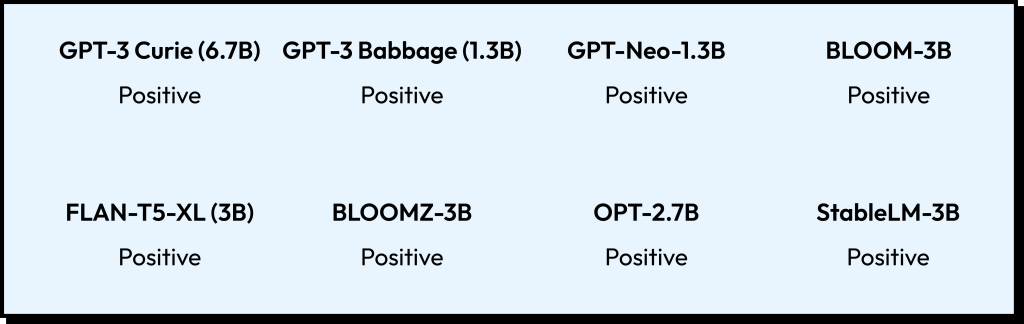
As we can see, open-source models have effectively solved this task.
TL;DR Summarization
The next task is to perform TL;DR summarization to highlight the key ideas from the text. The prompt:
A neutron star is the collapsed core of a massive supergiant star, which had a total mass of between 10 and 25 solar masses, possibly more if the star was especially metal-rich.[1] Neutron stars are the smallest and densest stellar objects, excluding black holes and hypothetical white holes, quark stars, and strange stars.[2] Neutron stars have a radius on the order of 10 kilometres (6.2 mi) and a mass of about 1.4 solar masses.[3] They result from the supernova explosion of a massive star, combined with gravitational collapse, that compresses the core past white dwarf star density to that of atomic nuclei.
Tl;dr
| GPT-3 Curie (6.7B) |  |
| GPT-3 Babbage (1.3B) | 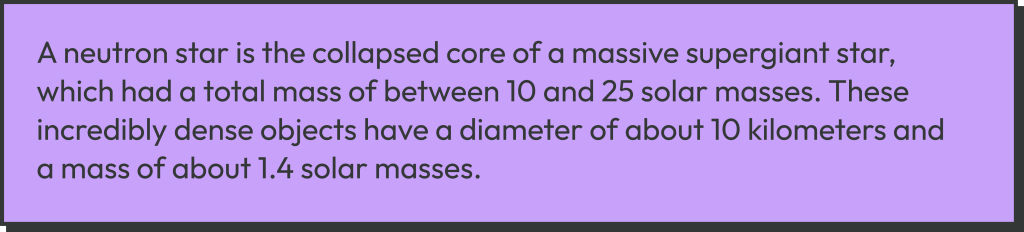 |
| GPT-Neo-1.3B |  |
| BLOOM-3B | 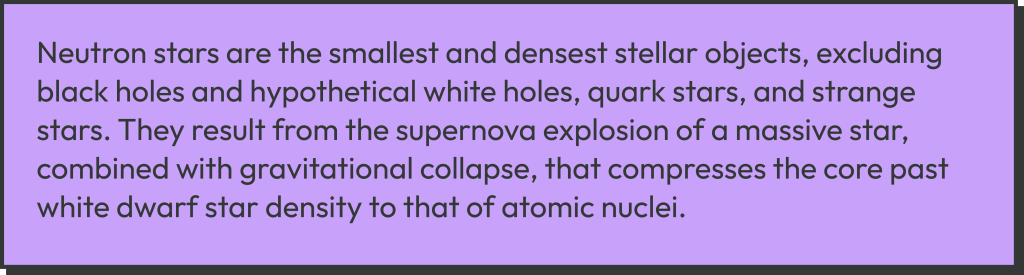 |
| FLAN-T5-XL (3B) |  |
| BLOOMZ-3B |  |
| OPT-2.7B | 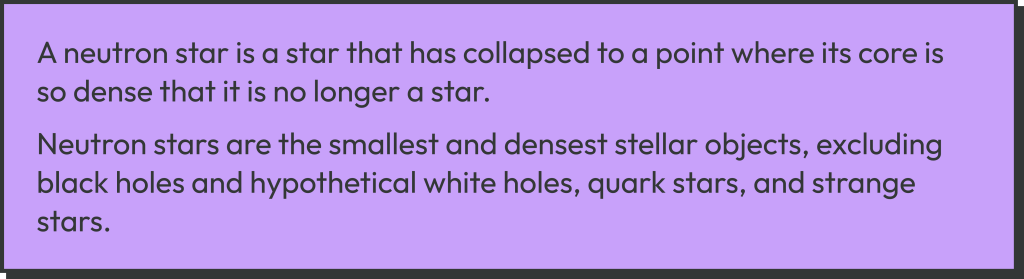 |
| StableLM-3B | 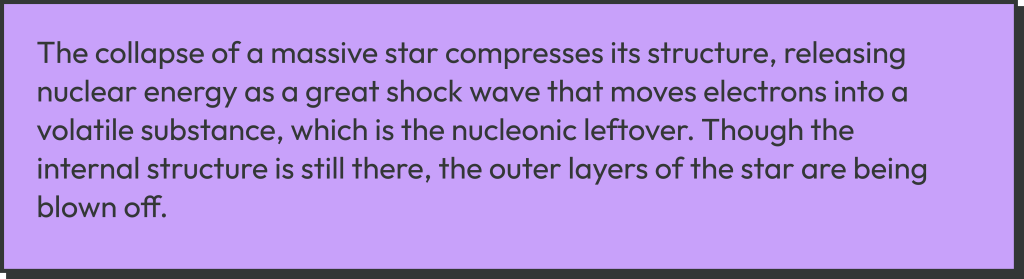 |
From these results, some models stick pretty closely to the structure and content of the prompt, while others hallucinate by inventing new facts. To fix this issue, we should consider changing the temperature parameter and/or sampling methods for new tokens.
Keywords Extraction
Now, we will be extracting keywords and keyphrases from the text using our open-source models. Our prompt looks like this:
Extract keywords from this text:
Black-on-black ware is a 20th- and 21st-century pottery tradition developed by the Puebloan Native American ceramic artists in Northern New Mexico. Traditional reduction-fired blackware has been made for centuries by pueblo artists. Black-on-black ware of the past century is produced with a smooth surface, with the designs applied through selective burnishing or the application of refractory slip. Another style involves carving or incising designs and selectively polishing the raised areas. For generations several families from Kha’po Owingeh and P’ohwhóge Owingeh pueblos have been making black-on-black ware with the techniques passed down from matriarch potters. Artists from other pueblos have also produced black-on-black ware. Several contemporary artists have created works honoring the pottery of their ancestors.
| GPT-3 Curie (6.7B) |  |
| GPT-3 Babbage (1.3B) | 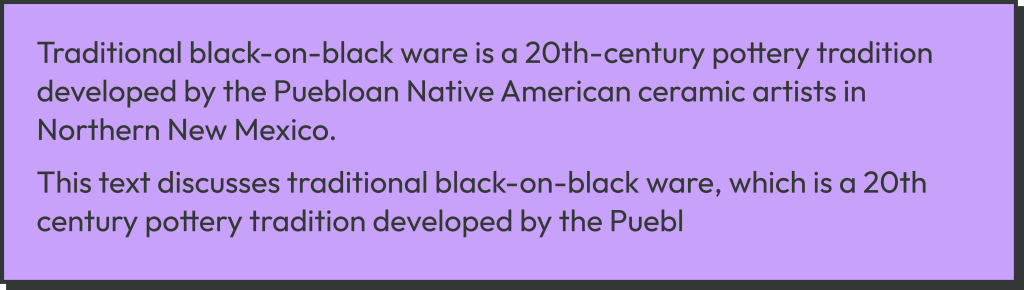 |
| GPT-Neo-1.3B |  |
| BLOOM-3B | 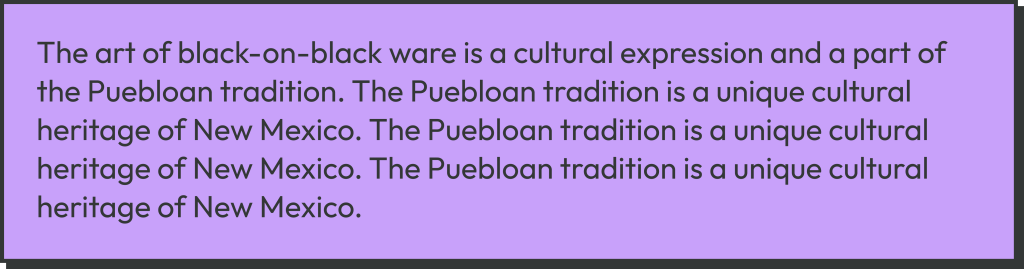 |
| FLAN-T5-XL (3B) |  |
| BLOOMZ-3B |  |
| OPT-2.7B |  |
| StableLM-3B | 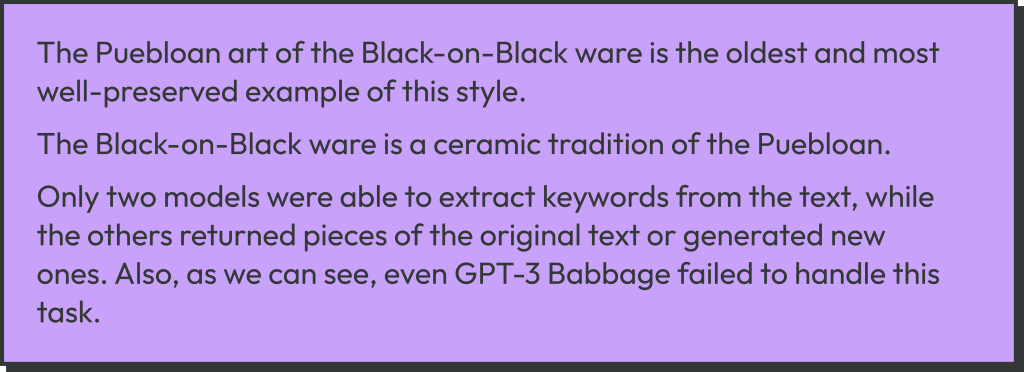 |
Only two models could extract keywords from the text, while the others returned pieces of the original text or generated new ones. Also, as we can see, even GPT-3 Babbage failed to handle this task.
Notes to Summary
Let’s try to create a summary from the meeting notes.
The prompt: Convert my short hand into a first-hand account of the meeting:
Tom: Profits up 50%
Jane: New servers are online
Kjel: Need more time to fix software
Jane: Happy to help
Parkman: Beta testing almost done
| GPT-3 Curie (6.7B) | 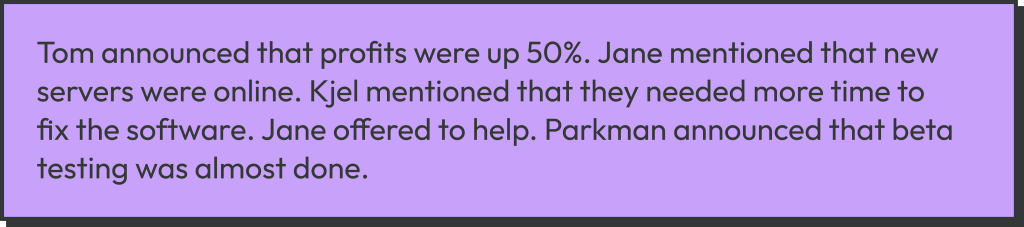 |
| GPT-3 Babbage (1.3B) | 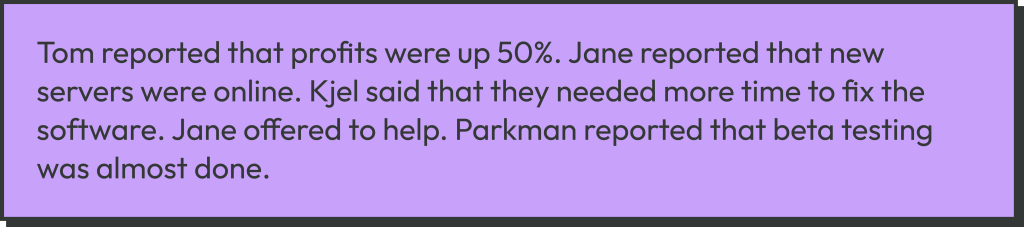 |
| GPT-Neo-1.3B | 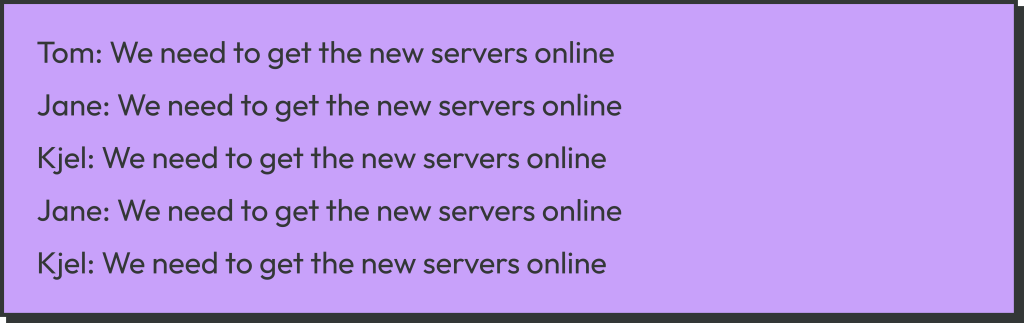 |
| BLOOM-3B | 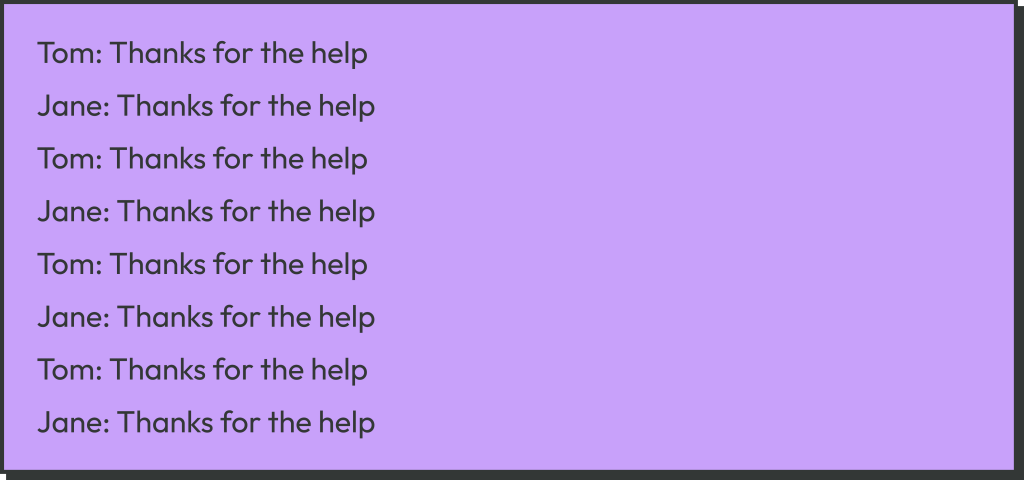 |
| FLAN-T5-XL (3B) |  |
| BLOOMZ-3B |  |
| OPT-2.7B | 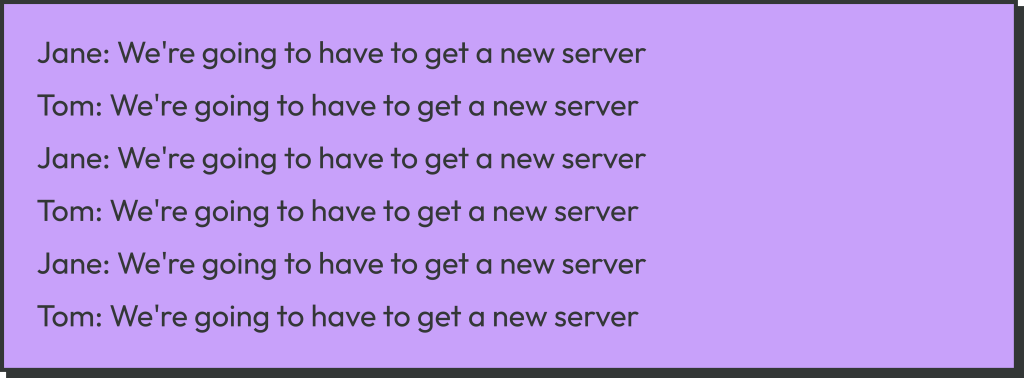 |
| StableLM-3B |  |
None of the open-source alternatives to GPT-3 could solve the problem of creating a summary from meeting notes, while GPT-3 Curie and Babbage easily handled it.

Explore our project:
Text Prompt Engineering for Image GenerationWhat about GPT-4?
The latest addition to OpenAI’s lineup of LLMs is GPT-4, which made its debut on March 14, 2023. This new version introduces significant advancements compared to its predecessor.
Notably, GPT-4 now possesses the capability to utilize image inputs to generate text, expanding its range of applications. Additionally, it boasts a larger context window, enabling it to consider more extensive contextual information during text generation.
While specific technical details about the architecture and training data of GPT-4 are limited, OpenAI affirms that it surpasses the accuracy of both GPT-3.5 and GPT-3. Furthermore, it showcases impressive performance across a diverse range of challenges, including tasks such as passing academic tests and coding websites based on images.
Presently, GPT-4 is exclusively available in chat mode via API, with completion mode only accessible for GPT-3. However, after gaining approval from the waitlist request, users can leverage GPT-4’s capabilities through the provided API. We are fortunate to have access to GPT-4 and are eager to test it on our selected problems.
| Tweet Sentiment |  |
| TL;DR Summarization | 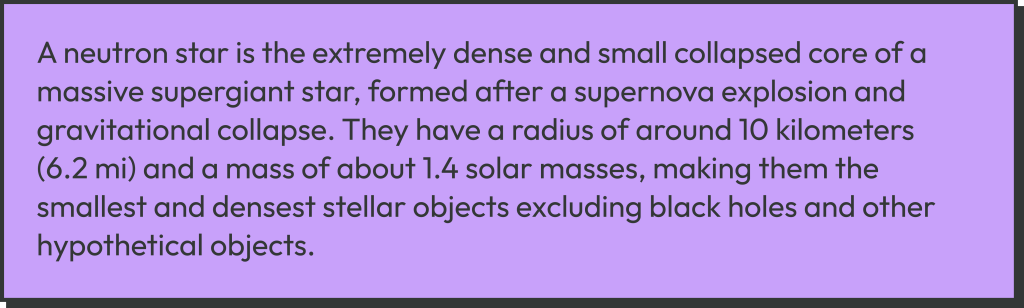 |
| Keywords Extraction | 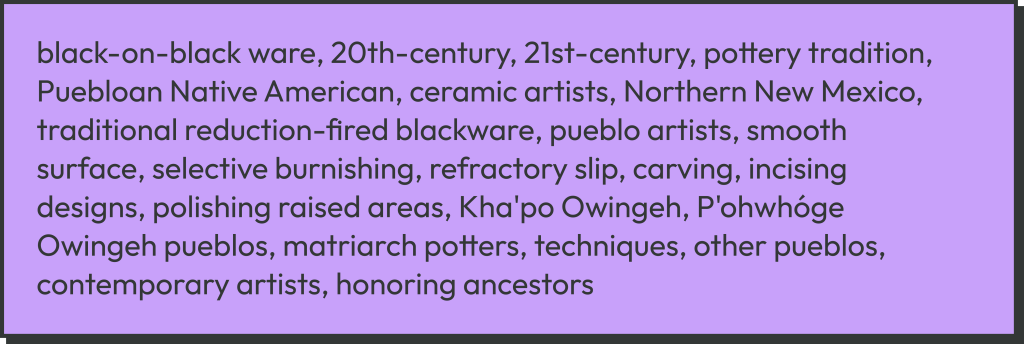 |
| Notes to Summary | 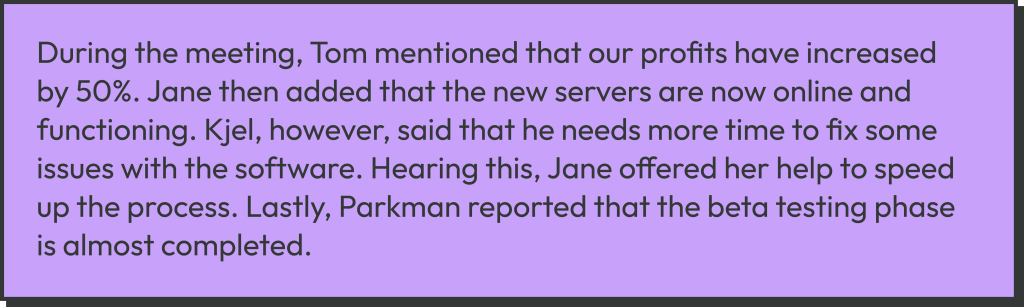 |
As expected, GPT-4 handled all the tasks extremely well.
How to Choose the Right GPT-3 Alternative for Your Needs
ChatGPT and GPT-3 have revolutionized the way businesses utilize artificial intelligence to automate communication, generate content, and streamline operations.
Here, we help you choose the right Chat GPT 3 alternative for your business needs and technical requirements, whether you’re looking for a service with better pricing, privacy, or performance or want to try out free alternatives to GPT-3.
Why Businesses Are Looking for GPT-3 Alternatives
OpenAI’s GPT-3 and ChatGPT have established high standards for performance and quality for natural language generation, but they also come with limitations:
- API access can be expensive at scale
- Data privacy and compliance may be a concern
- Limited customization or fine-tuning
- Dependency on external cloud providers
As a result, businesses are actively seeking ChatGPT free alternatives and other advanced large language models that offer greater flexibility, cost control, and deployment options.
Step 1: Define Your Use Case
Before you compare models, start by defining your core use case. Are you:
- Automating customer support with a chatbot?
- Generating blog content or marketing copy?
- Creating internal AI tools or copilots?
- Extracting and summarizing large documents?
Each of these use cases has different technical requirements. For example, content creation needs language fluency and creativity, while enterprise data processing might need long context windows and privacy controls.
In the table below, you can check some of the best alternatives to ChatGPT for a specific function.
| Task Type | Best Chat GPT Alternatives | Reasoning |
|---|---|---|
| General QA and chatbots | LLaMA-13B, FLAN-T5 XL | Balanced performance, instruction-tuned |
| Code generation | GPT-J, CodeLLaMA | GPT-J trained on code; strong performance |
| Multilingual tasks | BLOOM, LLaMA-3 | BLOOM covers >40 languages |
| Content generation | LLaMA, GPT-NeoX | High coherence, long context |
| Fine-tuning | GPT-Neo, GPT-J | Hugging Face-friendly; easy to adapt |
Step 2: Assess Model Capabilities
Once your goals are defined, the next step is to compare the capabilities of the available ChatGPT-3 alternatives.
Modern LLMs vary in their language fluency, reasoning capabilities, speed, and context window size. For example, Claude 3 and Gemini 1.5 have huge context windows (hundreds of thousands of tokens), which is great for long documents.
GPT-4o, Claude 3.5, and Gemini also support tool use and multimodal inputs (text, images, even audio) for more complex and interactive applications.
On the other hand, open-weight models like LLaMA 3, Mistral, and Mixtral have strong performance and customization. These ChatGPT alternatives are great for businesses that need domain-specific fine-tuning or full control over the model’s behavior.
Consider the following aspects in evaluating Chat GPT-3 alternatives:
- Language quality: Does the model produce human-like, coherent text?
- Context window size: Can it handle long conversations or documents?
- Speed and responsiveness: Is it fast enough for real-time applications?
- Multimodal input: Does it accept both text and images?
- Support for tools and APIs: Can it act as an intelligent agent or plug into business systems?
Some of the best Chat GPT alternatives in 2025 include:
- Claude 3.5 by Anthropic – Great for reasoning and long context use.
- Gemini 1.5 by Google – Multimodal, powerful, and deeply integrated with tools.
- GPT-4o by OpenAI – The latest and most capable from the GPT series.
- Mistral & Mixtral – Lightweight open-source options for self-hosting.
- LLaMA 3 – Meta’s open-source family with strong performance and fine-tuning capabilities.
Step 3: Choose Between Cloud and Self-Hosted Solution
When choosing a GPT-3 alternative, you need to consider your deployment:
- Cloud-based APIs (e.g., OpenAI, Google, Anthropic, Cohere): Fast to deploy, but third parties process your data.
- Open-source and self-hosted (e.g., LLaMA 3, Mistral, Falcon): Full control and privacy, ideal for regulated industries or offline environments.
If your business handles sensitive data or needs full compliance with regulations like GDPR or HIPAA, a self-hosted chat GPT alternative may be the best fit.
Step 4: Free and Open-Source Options
If budget is a concern, there are many free alternatives to GPT-3 that work well. They require more engineering effort to deploy and maintain but are ideal for businesses seeking cost-effective solutions.
Some top ChatGPT free alternatives in 2015:
- OpenChat: Lightweight conversational model with good dialogue handling.
- Mistral 7B: Good performance with low hardware requirements.
- LLaMA 3 (8B and 70B): Customizable models for your use case.
- Gemma by Google: Compact and efficient open-weight model.
You can run these free GPT-3 alternatives on your infrastructure (local or cloud), so you have more control over privacy and cost.
Step 5: Pilot and Compare GPT-3 Alternatives
Before committing to any solution, run a pilot project. Use the same prompts or tasks across 2–3 models and evaluate:
- Text quality and accuracy.
- Latency and scalability.
- Cost per generation.
- Integration ease (APIs, SDKs, third-party tools).
Many providers offer API tiers, allowing you to test the ChatGPT alternatives for free before making a purchase.
In conclusion, choosing the right Chat GPT-3 alternative is a strategic decision that depends on your specific use case, budget, infrastructure, and privacy requirements. Whether you’re building a chatbot, automating content workflow, or processing internal documents, there are now dozens of options beyond GPT-3.
What’s Next for Open-Source LLMs?
Open-source large language models (LLMs) have gone from research experiments to production-ready solutions.
LLMs like Mistral, Mixtral, LLaMA 3, and BLOOM are being adopted across industries. These models give you access to the latest language modeling innovations without being locked into expensive, closed platforms.
Today, enterprises, startups, and even hobbyist developers can use state-of-the-art models without closed APIs.
Until recently, Chat GPT alternatives were limited to text-only interactions. But in 2025, we’re seeing rapid growth in multimodal open-source models. These tools can process text, images, and even audio content.
- LLaVA and OpenFlamingo are vision-enabled LLMs.
- Bark and Whisper (developed by OpenAI but with open weights) are used for speech generation and transcription.
- More multimodal open models will appear shortly, rivaling commercial models like GPT-4 and Gemini 1.5 Pro.
This opens up new opportunities in virtual assistants, AR/VR, accessibility, AI-powered mobile development, and real-time surveillance powered by free, open tools.
Here’s where we at IT-Jim think the open-source LLM movement is headed:
- Enterprise-Ready Alternatives: Open models will match GPT-4 performance, enabling you to deploy securely and privately across healthcare, finance, and manufacturing.
- Multilingual Growth: Models like BLOOM 3 will address the lack of high-quality tools in underrepresented languages, making AI more inclusive and global.
- Edge and Mobile AI: Thanks to efficient architectures and quantization, we’ll see LLMs running natively on devices, phones, IoT hubs, and even cars.
- Custom, Domain-Specific LLMs: Fine-tuned, lightweight models trained on your company data will outperform general-purpose models for specific tasks.
- Open Multimodal Assistants: Fully open-source, multimodal agents (text + vision + speech) will power the next generation of personal and business AI.
To Sum Things Up
In conclusion, the rapid development and impressive capabilities of GPT-3 have taken the world by storm, sparking interest in the potential applications of AI in a wide range of domains.
However, the limited accessibility and affordability of GPT models by OpenAI have prompted a growing demand for open-source and free alternatives that can cater to a broader audience.
This article has provided an overview of GPT-3 and explored several chat GPT alternatives. While these options may not match the raw power of GPT-3 in specific tasks, they serve as valuable resources for developers and researchers.
The prominence of these best alternatives to ChatGPT has fostered an environment of innovation within the AI community, driving the continuous improvement and development of new language models. Future LLMs may eventually reach or even surpass the capabilities of GPT-3 and GPT-4.
Thus, businesses no longer need to rely solely on GPT-3 or closed APIs. With today’s ecosystem of free GPT-3 alternatives like Mistral, LLaMA 3, and BLOOM, it’s possible to build scalable, private, and cost-effective AI and machine learning solutions tailored to your needs.
Need Help Choosing or Integrating the Right AI Model?
At IT-Jim, we specialize in helping businesses integrate AI tools into real-world products. Whether you’re migrating away from GPT-3, building your chatbot, or exploring ChatGPT-3 alternatives, we can guide you through every step, from strategy to deployment.
Contact us today to explore how we can help you find and integrate the best LLM solution for your business.
