Clutch Names IT-Jim as The Best IT Services Company in Ukraine For The Second Year In a Row

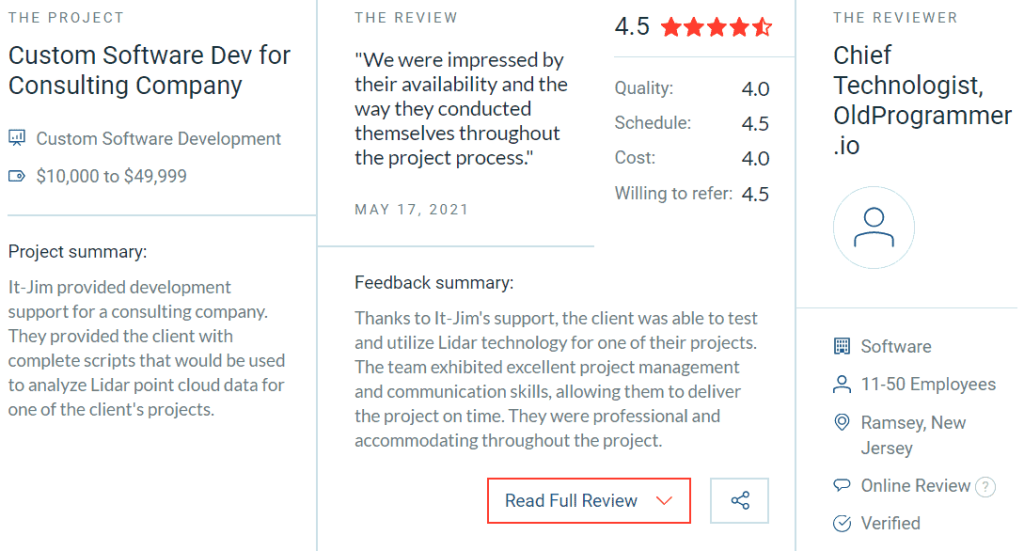
The It-Jim team is made of the best and most qualified professionals in the IT industry. Our high-quality research efforts give businesses the best possible chance of getting ahead in their respective fields. Now those same companies are giving back as they’ve helped name us the Clutch Top IT Development & Services team for 2021.

Clutch is a review and rating platform that uses a unique verification process that only allows legitimate information and reviews to be published on their website, such as these.

This prevents companies from sabotaging their competition or artificially boosting their own credibility. Because of the strict criteria, the Clutch award has become one of the most prestigious accolades in the B2B industry. A B2B startup team like ourselves are deeply honored and humbled to be one of its recipients for the last two years.

Ukraine is becoming one of the fastest growing IT hubs in the world and the field grows more competitive with each passing day. The fact that we’ve maintained our place at the top is a testament to the growth and consistency of our team.

Let us show you what an award-winning team can do and consider partnering with us for your next project.

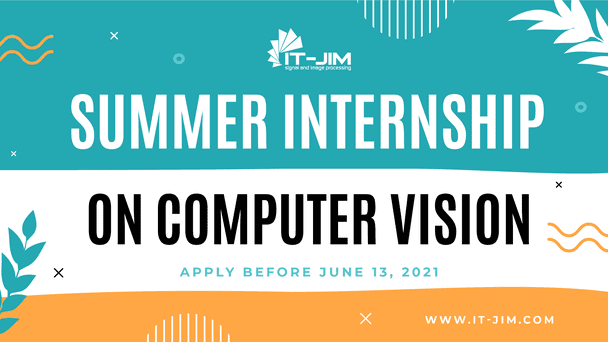
It-Jim’s Summer Internship on Computer Vision

Summertime sadness has no chance this year: can summer spent as a computer vision intern has anything to do with sadness? We don’t think so!

A 1-month online full-time internship on computer vision, where you will be working on a pilot project under the guidance of It-Jim’s experts. This is our offer. Do you take it?

Before you say yes

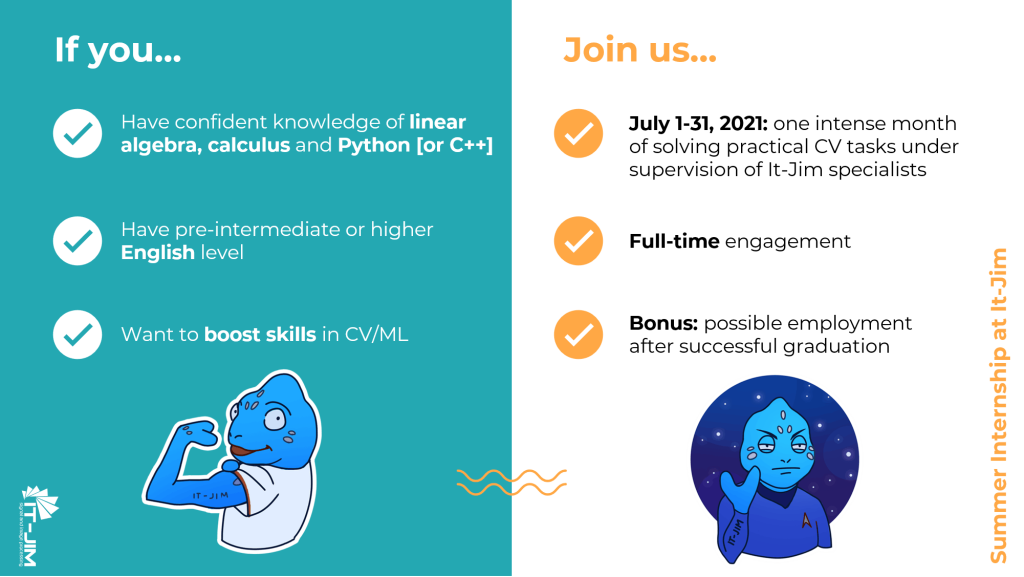
We’ll start on July 1 and for one month will be supervising you in your work. While most of the projects that we will offer deal with computer vision, you can also choose to work on audio or speech-related tasks. The internship will be held online, full-time engagement is expected. Each intern will have their own mentor to turn to. The work will conclude in early August with a project defense. 

What’s in it for you?

Everybody has their reasons. You might want to try out the CV/ML/DL domains and understand if this is something you want to pursue further. Or add a commercial-like experience to your CV and stand out at your next job interview. Or start your career as a computer vision engineer with us. Or simply you are passionate about CV so much that you are looking for any opportunity to gain new experience and expand your horizons. 

Whatever the reason is, we’d be happy to welcome you on board.

What you should know to become an intern

Here’s a shortlist of things you should check before applying. Our intern is someone who has:

  • strong programming skills (Python or C++),
  • confident knowledge in calculus, linear algebra, and probability,
  • at least a pre-intermediate level of English, 
  • (last, but not least) strong motivation. 

Is everything here about you? Fill in the form by June 13, 2021, and wait to hear from us soon after. We’ll pay extra attention to motivation so invest some time into thinking it through. 

After the initial processing of applications, we’ll send a test task to the selected candidates. They will have one week to work on it. At the final stage, we will interview those who offered the best solutions.

A brief history of time our educational projects

This is the fifth edition of both internships and schools on computer vision that we are organizing. While we had 19 applications during the first one, over 160 people wanted to join the last launch of our internship in winter 2021.  We selected 4 interns that time, and they got to work on quite various tasks: estimation of person’s vital signs from a front phone camera, building a shazam-like engine, floor segmentation, and real-time background replacement in images. This year, the set of projects is going to be no less intriguing 😉

To sum up

Ready?

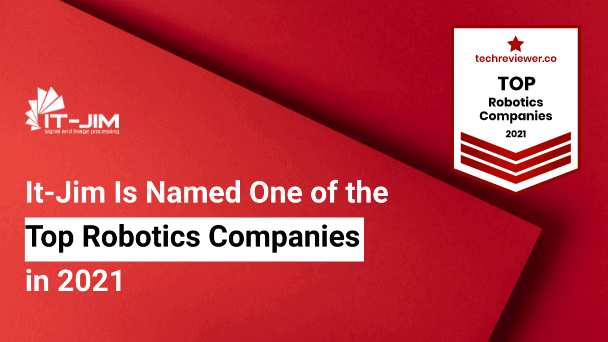
It-Jim Is Recognized as One of the Top Robotics Companies in 2021

The analytics team TechReviewer has ranked It-Jim among the top robotics companies in 2021. Analysts at TechReviewer carefully select agencies based on company ratings, social media mentions, service quality factor, company’s business history and expert opinions.

The It-Jim team is honored to be included among such an esteemed list of robotics companies. We are extremely grateful for participating in TechReviewer’s ranking process and appreciate the high marks and recognition.

Since 2015, It-Jim has been providing high-quality services in the field of computer vision, pattern recognition, machine learning, artificial intelligence, augmented reality, signal and image processing. Its core development team brings an admirable level of proficiency and dedication to every project, outperforming the industry competition and constantly attracting prospective customers.

About TechReviewer.co

 TechReviewer.co is a research & analytics team founded in 2019 that carries out studies and compiles the lists of the leading software development companies in various categories based on the market research and the analysis of reviews.

TechReviewer helps to connect the business and find optimal vendors that meet the high requirements for providing quality services.

It-Jim’s 2021 Winter Internship on Computer Vision: an Overview

A student that is about to graduate from the university and has not yet made up his mind about the career he wants to pursue. A freelancer who has already tried a lot of technologies, knows how he wants to develop himself further and would like to gain experience of working in a company. An experienced IT engineer totally burnt out and aiming to find a new passion. A professional architect (not software one) switching his career entirely. 

Do they have anything in common? Yes. All of them have successfully finished It-Jim’s winter internship on computer vision and are now one step closer to achieving their career goals in computer vision and machine learning domains.

The Second Edition of It-Jim’s Winternship

Have you ever noticed that the words “winter” and “internship” are made for each other? Or is it just us? The second edition of what we now call “winternship” on computer vision turned out a huge success. We started the campaign in the middle of December 2020, and in three and half weeks we received a truly overwhelming number of applications – 164, a 5x increase compared to the last year! Could we be any happier? Unlike the first edition, this time we had to switch the format to online only due to the ongoing epidemic situation. Yet, we even benefited from it. The geography of applicants this time was quite impressive: Kharkiv, Kyiv, Lviv, Dnipro, Odessa, and many other cities in and outside of Ukraine. 

Was it a fun ride selecting the four best candidates out of 164 applications? Most definitely, yes. Especially when there were only 4 spots available. After first filtering the list, we have sent test tasks to 120+ applicants to further narrow down the circle of candidates. Out of 53 participants who tried to solve those tasks we chose 13 persons for interview. Finally, here there were: a student, a freelancer, an IT switcher, and an architect… 4 (w)interns. 4 projects to work on. 4 mentors to guide. 4 weeks to go. 

Winternship 2021 Stats

The Rainbow of Projects

Each of the interns worked on their own project under the guidance of It-Jim’s mentors. We wanted projects that both solved unusual computer vision tasks and were challenging enough for interns, so we opted for the following ones:

  • creating the Shazam-like application: a program that is able to recognize audio or a sound within a few seconds,
  • real-time background replacement in images: a module that segments foreground from background in a webcam stream
  • extraction of heart rate from the mobile phone selfie camera: a solution which performs a sort of magic and estimates the heart rate from a video only
  • floor segmentation application: a module that automatically located the floors of an arbitrary shape and locates them based on camera images and iPhone’s LiDAR’s raw data.

Let’s now dive into their realization.

Music Recognition

In this project, we wanted to compare two approaches, namely spectrogram analysis and deep learning, for the task of music recognition. 

The shazam-like algorithm had the following pipeline: 

  • getting a spectrogram of a song using the Fourier transform, 
  • creating fingerprints for the recorded sample: finding the frequency peaks in the spectrogram, grouping them to the target zones, and pairing them with anchor points
  • matching the fingerprints from the unknown sample against a set of fingerprints derived from the music database.
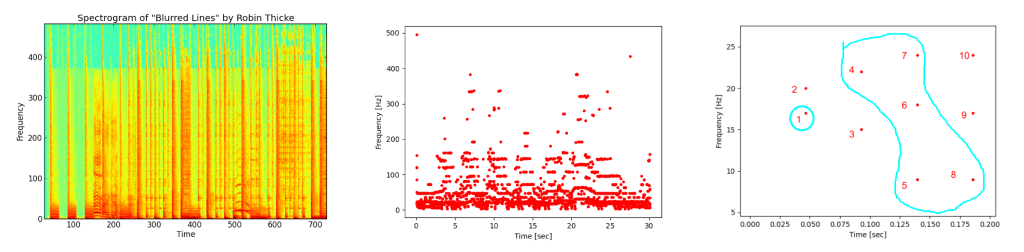
Song spectrogram and its target zone example

The deep learning approach to song similarity estimation had the following steps:

  • We extracted compact 128-number embeddings for each song using Siamese neural network.
  • Triplet loss was used within the training pipeline (analogy with face recognition)
  • Random crops from spectrograms were used as the input dataset
  • 10+ different classifiers were applied for actual song recognition

As a result, our intern has demonstrated real-time music recognition for a moderate song dataset. This indicates that audio processing is also about computer vision.

  • Tools and technologies: signal processing, classical computer vision, machine learning, deep learning.

Monodepth Background Replacement

The goal of the project was to develop software that would replace the background behind a person on a video. The core idea was to utilize a monocular depth estimation model to calculate a depth map that can later be used to split the object and background

  • Initially, our intern started with the DenseDepth model trained with the NYU dataset. The DenseDepth model application frame-by-frame gave around 16 FPS only which was not enough for real-time video processing. 
  • We have easily achieved 30+ FPS via incorporation of the optical flow between adjacent frames to track movements and keep the consistency of the depth map
  • To get a binary mask, our intern added two options: to select a manual threshold or apply Otsu method which does the job automatically. 
  • Finally, some post-processing was applied to filter out the false contours from the background.

An alternative solution was based on the U2-Net model that is usually used for salient object detection. Trained on the Supervisely Person dataset, it managed to give more accurate background replacement compared to the depth estimation approach (see figure below). Also, unlike depth estimation models, it correctly handled cases when a person walked away from a camera view, leaving just an empty background. 

After a couple of experiments, our intern provided a real-time demo for background replacement.
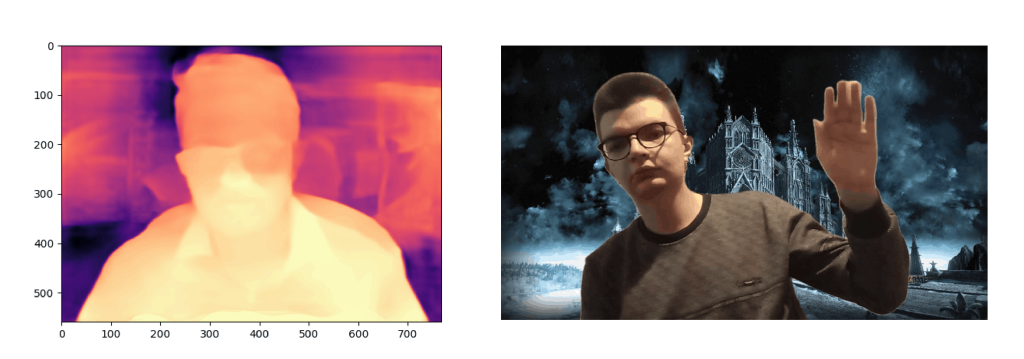
Depth maps predicted by AdaBins trained on NYU (left) and background replacement based on predictions of U2-Net trained on Supervisely Person dataset (right)

  • Tools and technologies: Python, OpenCV, PyTorch, classical computer vision, deep learning.

Extraction of Heart Rate from the Frontal Camera

The goal of this project was to calculate the heart rate from a video of a person’s face using remote photoplethysmography (rPPG). The latter is based on the blood volume changes in tissue due to the cardiac activity that affects the optical characteristics of reflected light. A proper heart rate measurement is possible only in the case of efficient capturing the changes of red, green, and blue color components. Generally, the rPPG framework consisted of the following steps:

  • Face and ROI (region of interest) detection.
  • Facial landmarks extraction and tracking.
  • PPG signal extraction and processing. After locating the ROI, a single RGB signal was extracted by averaging pixel values over the region. Additional filtering and processing were applied to extract photoplethysmographic information from the raw PPG signal. 
  • dynamic heart rate estimation from the signal spectrogram

As a result, our intern has provided a real-time demo performing the heart rate estimation from a webcam.

Example of ROI detection (left) and heart rate extraction from the PPG signal (right)

  • Tools and technologies: OpenCV, Python, signal processing, classical computer vision

Floor Segmentation

The goal of the final fourth project was to create a pipeline allowing the automatic floor segmentation and replacement in indoor images. We have provided both conventional images from the mobile camera as well as raw data from iPhone’s Pro 12 LiDAR. 

Initially, our intern tried to cluster the images using K-means based on pixel coordinates and color components in HSV, RGB and Lab spaces.

As for LiDAR data, we recalculated the raw data into a proper 3D point cloud using the camera intrinsics. Secondly, a RANSAC algorithm was used for the plane fitting. 

Finally,  a basic fusion scheme was applied to combine the inliers from the RANSAC outputs with merged image clusters.

Depth maps and floor segmentation results

  • Tools and technologies: OpenCV, Python, classical computer vision, sensor fusion 

Summary

Why do people search for internships? Because it is a perfect way of getting to work on real industrial projects and gaining first-hand experience and mentorship from the experts. It is also a good try-out of the specific field and helps to make one’s mind about the future profession. 

Why do we have our internship program? Because we aim at making more people fall in love with computer vision and sharing the knowledge with future generations of engineers. 

We organize internships at least once a year. If you missed the last edition, don’t worry: a new type of internship, trainee program, is coming very soon 😉


 

It-Jim takes part in Prof2IT project of Kharkiv IT Cluster

We love teaching. That is why we hold internships and schools, organize applied computer vision meetups, and deliver open lectures at universities. Until autumn 2020, our audience mainly included students, interns, and developers, but now it also has Kharkiv university teachers on the list. Being invited by Kharkiv IT cluster to deliver a course on computer vision and machine learning for lecturers of IT specialties working at Kharkiv universities and colleges who seek to improve their qualifications, we joined the Prof2IT project and contributed to educators’ professional growth.

What is Prof2IT?

The Prof2IT project, held jointly by Kharkiv IT Cluster and Kharkiv University of Technology “Step”, aims at helping Kharkiv university teachers of IT specialties improve their skills and update their knowledge on specific IT and data science disciplines. Additionally, it is targeted to update the course materials they teach in accordance with the modern requirements of the IT industry.

With this project brought to life, Kharkiv IT Cluster contributed to direct communication between the IT industry and the teaching community. IT businesses are interested in ensuring that people who graduate from universities and come to work for them are highly competent and the market is saturated with highly-qualified young talents. Is it always the case? Unfortunately, no. How can we help as a company? We can train a teacher, and let the geometric progression of spreading knowledge do the rest.

Course on Computer Vision and Machine Learning

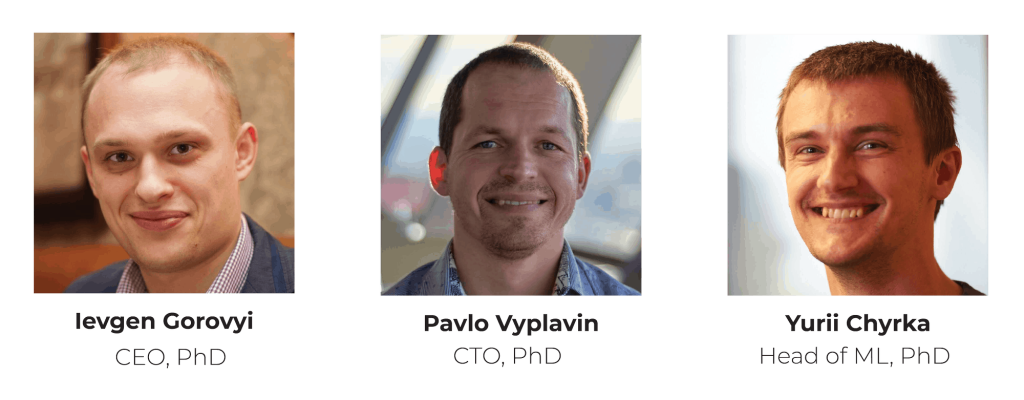
Our online training course “Applied Computer Vision: from Classic Image Processing to Machine Learning and Deep Learning” started on November 5, 2020, and lasted for two months.  Twenty lecturers from ten different Kharkiv educational institutions including but not limited to Kharkiv National Polytechnic University “NTU KhPI”, Kharkiv National University of Radioelectronics and V. N. Karazin Kharkiv National University joined the course. All the materials were delivered by our experienced team: 

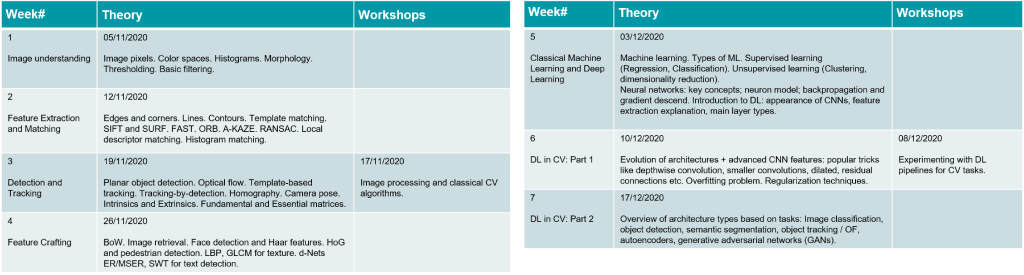
What did the course include? Seven lectures divided into two modules and 2 workshops that covered all the basics both in classical computer vision algorithms, machine learning, and deep learning. The listeners could update their knowledge on the theoretical foundations of the formation of digital images and their analysis using different tools. 

In the first part, we have covered some basics in image understanding and processing like color spaces, histograms, filtering, image gradients, thresholding, and morphological operations. The classical CV module also included feature extraction and matching; lecture on detection and tracking which included an overview of homography, RANSAC, camera calibration, optical flow and template-based tracking, and finally lecture on feature crafting, the bridge between classical approaches and machine learning.

The second module featured an introduction to both classical machine learning algorithms and neural networks. We covered the very basics of deep learning (neuron model, backpropagation, gradient descent, etc.) as well as the evolution of neural network architectures, different types of convolutional layers and regularization techniques, GANs, autoencoders and different task-specific architectures of neural networks.

With this course, we hope to contribute not just to the professional development of the teachers who attended the course but also to the modernization of the corresponding training courses in universities and colleges of the city.

Winter Internship on Computer Vision: Time to Become a CV Engineer

While 2020 has shown us that new year resolutions might not work, we do not think anyone should give up making a clear vision for the upcoming year. Especially if there is a “become a computer vision engineer” on the list.

Nope, we can not tell for sure what 2021 will be like. Yet, being optimists, we promise you this: the start of the next year can be full of discoveries, exploration and even have elements of intrigue. All those things combine when it comes to research in computer vision, and with our winter internship, we are offering you to discover this exciting field for yourself.

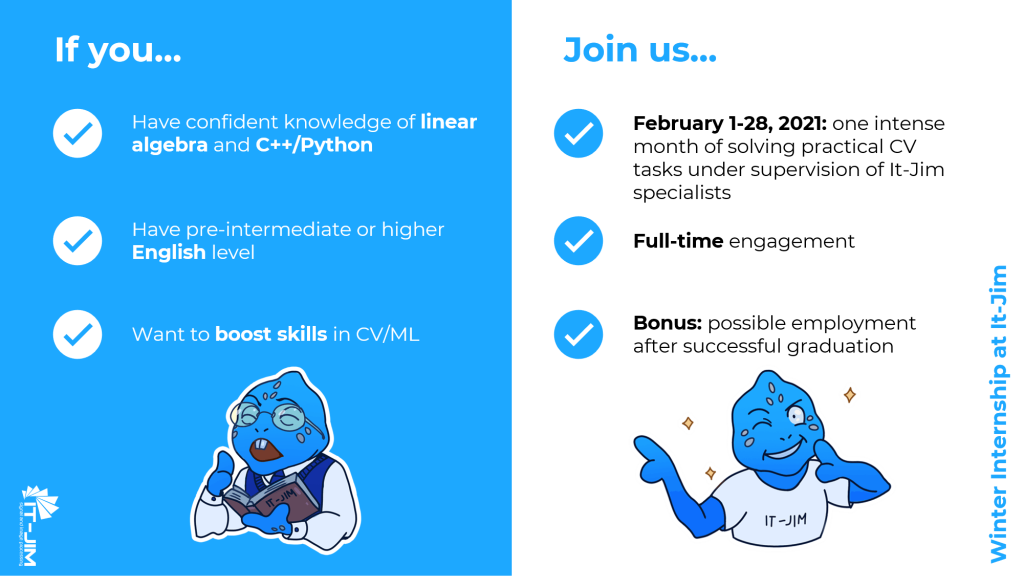
Starting February 1, 2021, and for full 4 weeks, you are invited to work on a real computer vision project under the supervision of It-Jim experts. This is a full-time engagement and quite an intense month of diving into the CV/ML/DL world.

What exactly does internship mean?

You might have heard about our summer internships before. Unlike those activities, winter internship-2021 will not have lectures nor workshops. Instead, it will bring you a full immersion into an exciting research project with lots of experiments, deep analysis of algorithms, and their implementation. What is more, you will be guided by experienced It-Jim engineers and learn the practices from the best.

At the end of the internship, you will be asked to make a presentation to showcase your achievements throughout the month. Our vibrant team is always open to bright engineers… What if this could be the start of your career?

How do you know if this is for you?

First, ask yourself if you are eager to dive into the world of visual intelligence. Because once you start, there is no turning back – it is THAT interesting! You know how they say: once a computer vision engineer, always a computer vision engineer 😉

We do not ask much. With a confident knowledge in linear algebra and C++/Python, preintermediate+ level of English, and strong motivation to learn fast, your chances are high. Some analytical and problem-solving skills would not hurt, too.

Are you the one we are looking for? Do you want to enter the world of computer vision? We will provide you with one of the best possible platforms in Ukraine to do that.

Fill in this form: https://forms.gle/6gtvzFBurnXNGsAG7, and let’s find out. We are accepting applications until January 10, 2021. To become an intern, you will need to solve a couple of basic tasks. They will be sent out after the application submission deadline. You will have two weeks to show us what you got.

It-Jim’s winter-2021 internship in a nutshell

Should you have any questions, please contact Daryna Pesina, COO of It-Jim, at darynapesina@it-jim.com.

The Second Edition of It-Jim’s Summer Internship: 8 and 1/2 Weeks of Diving into Computer Vision


For us, summer 2020 wasn’t just about washing our hands more thoroughly than usual, but also about the very successful second edition of our internship on computer vision.

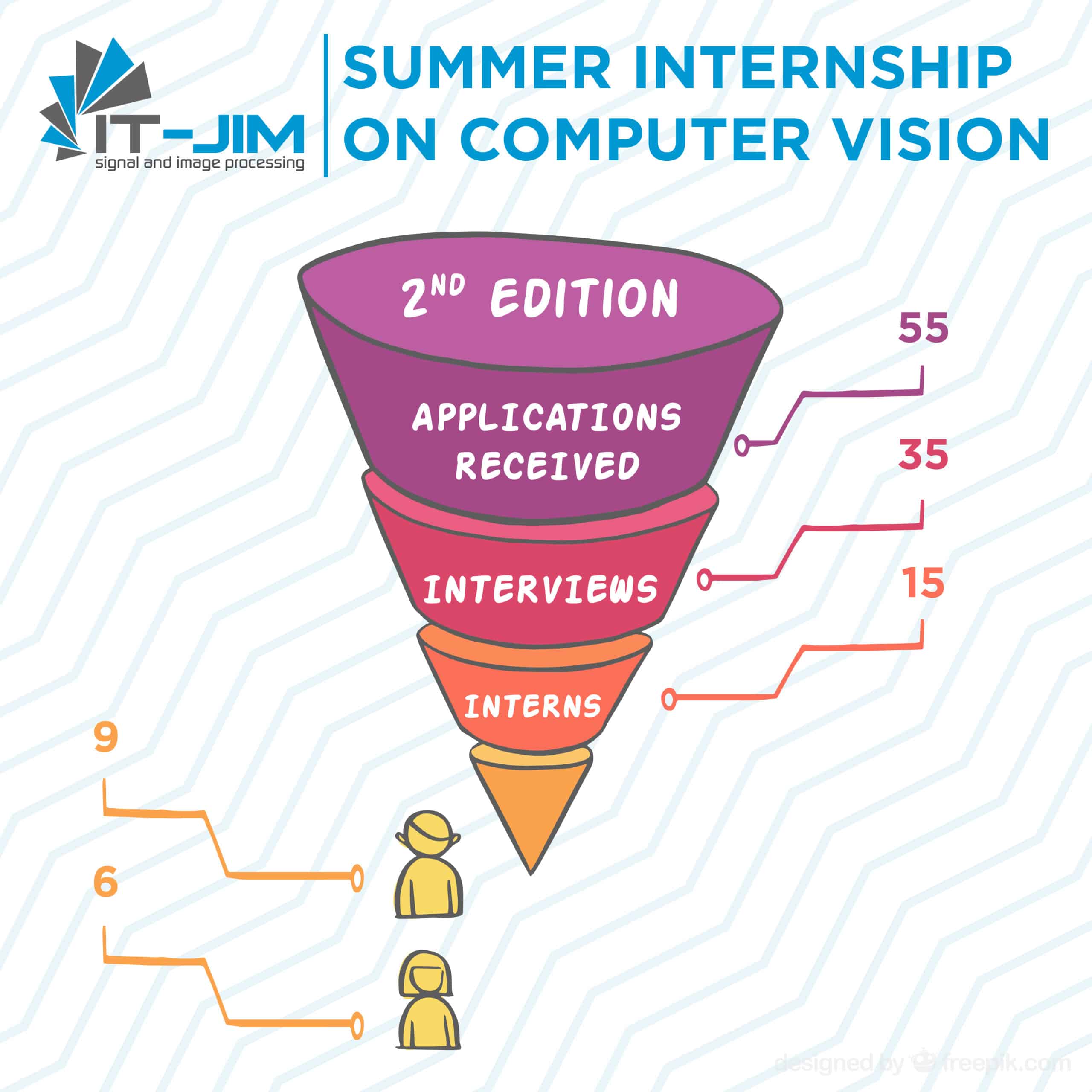
First announced in May 2020, this edition of internship managed to attract almost 60 applications from not just Ukraine, but also Germany, Belgium, and India. We were truly excited to receive three times more applications than last year. After the initial pre-selection, we have conducted 35 interviews with potential candidates and chosen 15 best applicants to become our interns. The Covid-19 had its consequences on the format of the internship: we mixed the offline mode of studying with the online one to ensure everybody’s safety. We have also combined theoretical talks with the supporting workshops that included the practical implementations of the concepts from lectures and weekly homework reviews. The material was delivered by our super experienced team: Ievgen Gorovyi, CEO, PhD, Pavlo Vyplavin, CTO, PhD, and Yurii Chyrka, ML/DL Team Lead, PhD.

The course program consisted of two major modules, one month long each: 

  • classical computer vision, 
  • machine learning and deep learning algorithms for computer vision tasks. 

We started with the basics in image understanding and processing and gradually paved the way through image matching, object detection and tracking towards image content description and feature crafting, the bridge between the classical computer vision and machine learning. In the second half of the course, we covered different types and classical algorithms of machine learning, as well as neural networks basics, the evolution of convolutional neural networks, and the most popular architectures. A detailed description of the course program can be found here.

As part of the homework, interns were suggested to solve a bunch of typical computer vision tasks. Supervised by It-Jim’s experts, they gained experience in basic image manipulations, pattern detection and recognition, tracking objects in video, image retrieval and classification, feature crafting for machine learning, transfer learning, semantic segmentation. Our interns became familiar with the most popular DL frameworks: Keras+Tensorflow and Pytorch. 

We have always paid a great deal of attention to the growth of the Ukrainian CV community and done our best to replenish it with high-skilled engineers. We have no doubts that our graduates will keep on rocking and definitely succeed as computer vision professionals.  

Last, but not least, If you are interested in mastering computer vision, yet missed our internship this year, be sure to visit our website to find the announcement of the second winter school and the third edition of the summer internship next year! You can also follow us on social media and stay tuned to what we offer:


Clutch Recognizes It-Jim as a 2020 Top B2B Company in Ukraine

Artificial intelligence (and computer vision in particular) are changing the way we all work, live, and communicate. It can seem daunting to attempt to keep up with all these emerging technologies and tends, however, you don’t have to worry because that’s why we’re here!

Since 2015, we’ve been established as a group of experts who conduct high-quality research in the fields of computer vision, pattern recognition, machine learning, augmented reality, and signal and image processing.

Over the years, we’ve completed many projects from building an indoor navigation engine to developing sophisticated mixed reality systems.

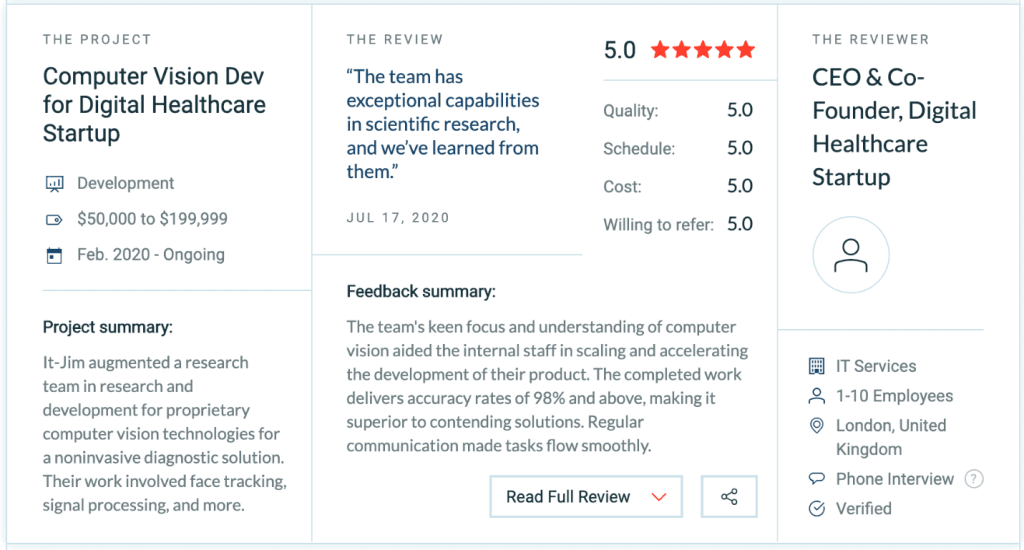
In a current ongoing project, we’re providing computer vision development efforts for a digital healthcare startup. They’re striving to decrease the cost of healthcare around the world while increasing accessibility to world-class diagnostics.

Remember what we said about emerging technologies impacting our everyday lives? One of our clients is utilizing these technologies to make a difference. The CEO of the startup shared, “Our goal was to be able to diagnose health conditions in patients noninvasively. They’ve aided us in accelerating the research process by looking into new ways of diagnosing COVID-19 in ways that can be accessible to everyone with a consumer technology device, such as a smartphone.”

“Their expertise and specialization within the computer vision field are fantastic. The team has exceptional capabilities in scientific research, and we’ve learned from them.” –CEO & CO-Founder, Digital Healthcare Startup

We’re so humbled by our clients and their desire to cause positive change, and we take pride in being your partner to do so. This honor is paired with our appreciation of recently receiving a company award: we were named a 2020 top B2B company in Ukraine by Clutch, a research and review platform for business owners. You can find the official press release with the full list of leaders here.

You can also find us among a 2020 top machine learning companies in Ukraine. Clutch’s research says and establishes that we’re a leading agency in our field and we possess a strong commitment to high-quality customer service.

We are very grateful to our clients for dedicating their time to provide the feedback on our work! What’s more, we couldn’t have received this award without you. Thank you very much!

Remember we’re always one message away if you ever need to get in touch with us!

About Clutch

Clutch is the leading ratings and reviews platform for IT, marketing, and business service providers. Each month, over half a million buyers and sellers of services use the Clutch platform, and the user base is growing over 50% a year. Clutch has been recognized by Inc. Magazine as one of the 500 fastest-growing companies in the U.S. and has been listed as a top 50 startup by LinkedIn.